
When a child spends the morning building a den, mixing mud, sorting leaves, pretending to run a café and negotiating whose turn comes next, it can look wonderfully simple. Yet this is exactly why a thoughtful play based curriculum guide matters. Behind joyful moments, the best early years settings are carefully shaping language, confidence, motor skills, early maths, social awareness and the habits that help children thrive in school and beyond.
For many parents, the question is not whether play matters. It is whether play is enough. The reassuring answer is that high-quality play is never aimless. In the right environment, it is purposeful, well planned and guided by trained teachers who understand child development. A strong curriculum uses play as the vehicle for deep learning, not as a break from it.
What a play based curriculum guide should actually show you
A good play based curriculum guide should help parents see what children are learning, how they are learning it and why that approach is appropriate for their age. It should not read like a list of random crafts or free time activities. Instead, it should reveal a clear developmental journey.
For children aged 2 to 7, this journey usually begins with security, routine and sensory exploration. Young children first need to feel safe enough to investigate the world around them. From there, play can support speech, listening, co-ordination, curiosity, memory, self-regulation and problem solving. As children grow, those same playful experiences become more sophisticated. A simple water tray can become an early science lesson. A role-play corner can strengthen storytelling, vocabulary and social understanding. Outdoor exploration can sharpen observation, resilience and physical confidence.
This is why the curriculum matters so much. The play itself may look natural, but the teaching behind it should be intentional.
Why play is the right foundation for early learning
Children do not learn best by sitting still for long stretches and absorbing information passively. In the early years, they learn through movement, repetition, sensory experience, imitation and conversation. Play allows all of these to happen at once.
When a child lines up stones from smallest to largest, they are beginning to understand sequence and comparison. When they retell a story through puppets, they are developing language, recall and imagination. When they climb, balance and run outdoors, they are building core strength that later supports writing and concentration. Learning is interconnected in the early years, and play reflects that beautifully.
There is also an emotional reason play matters. Children are more likely to take risks in their learning when they feel curious rather than pressured. They ask more questions. They try again after setbacks. They begin to trust their own ideas. These qualities are not extras. They are part of true school readiness.
That said, balance matters. Parents are right to ask how children will move towards phonics, number awareness, mark making and classroom routines. A strong play-based approach does not avoid academic foundations. It introduces them in developmentally suitable ways, often through games, stories, hands-on materials and guided experiences.
The key parts of a strong play based curriculum guide
The most helpful play based curriculum guide will usually include several essential elements, even if the school describes them in its own way.
Clear developmental stages
Children change quickly between the ages of 2 and 7. A two-year-old needs a very different rhythm from a six-year-old. The curriculum should reflect this through age-appropriate expectations. Early stages may focus on separation confidence, sensory play, communication and simple routines. Later stages should build towards stronger concentration, collaborative play, early literacy, numeracy and independent thinking.
A staged pathway gives parents confidence that their child is not being rushed, but also not being left to drift.
Intentional teacher guidance
Play-based learning is sometimes misunderstood as adults stepping back completely. In reality, skilled teachers know when to observe, when to ask a question, when to model language and when to extend a child’s thinking. If a child is stacking blocks, a teacher might introduce words like taller, shorter, heavier or balanced. If children are role-playing a shop, the teacher might bring in counting, writing labels or turn-taking language.
This kind of teaching keeps the experience warm and child-centred while still moving learning forward.
Rich indoor and outdoor environments
The environment is part of the curriculum. Children need spaces that invite exploration, creativity and movement. Indoor areas should offer open-ended materials, books, sensory invitations, art opportunities and spaces for quiet focus. Outdoor areas should be more than a playground. They should function as living classrooms where children can investigate weather, texture, movement, plants, insects and physical challenge.
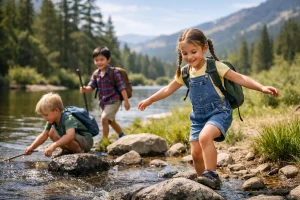
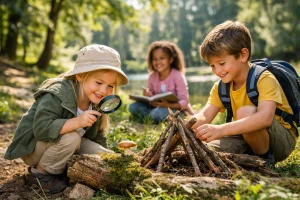
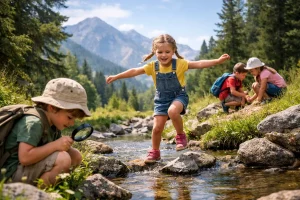
Nature-connected learning is especially powerful because it engages the senses so fully. Children often show greater calm, better attention and more imaginative play when they spend meaningful time outdoors.
Observation and assessment
Parents often worry that if children are learning through play, progress may be hard to measure. Good settings address this through regular observation. Teachers notice what children say, do, attempt and repeat. They track development over time and use those observations to plan the next experiences.
Assessment in the early years should feel thoughtful rather than heavy. The aim is to understand the child, not to reduce them to a checklist.
How play builds school readiness without pushing too soon
School readiness is sometimes framed too narrowly, as if it only means knowing letters, numbers and how to sit at a table. Those skills do matter, but they rest on a much broader base.
A child who can listen to a story, cope with a small frustration, follow a routine, speak to a teacher, use the toilet independently, hold a pencil with growing control and join in with peers is far better prepared for school life than a child who has memorised facts but struggles emotionally or socially.
This is where play does some of its best work. Through games, shared projects, music, movement and imaginative scenarios, children practise waiting, listening, expressing needs, resolving disagreements and persisting with a challenge. These are the quiet foundations that make later academic learning more secure.
There is, of course, a trade-off to manage. If a setting focuses only on free exploration without enough structure, some children may miss chances to build early academic confidence. If it becomes too formal too early, children may lose motivation or begin to see learning as stressful. The strongest programmes hold both truths together. They protect childhood while steadily preparing children for the next stage.
Questions parents should ask when comparing schools
If you are choosing a preschool or kindergarten, ask how the curriculum connects play with outcomes. Ask how teachers plan for different ages and abilities. Ask what a typical morning looks like and how much time children spend outdoors. Ask how communication, early literacy, numeracy and personal development are supported through daily experiences.
It is also worth asking how the school helps children grow in confidence and kindness. Academic preparation matters, but a warm community, cultural awareness and emotional security shape the whole experience.
When you visit, look beyond displays on the wall. Notice whether children seem settled, engaged and eager. Notice whether teachers are talking with children rather than simply directing them. Notice whether the environment feels inviting, orderly and alive with possibility.
What this looks like in practice
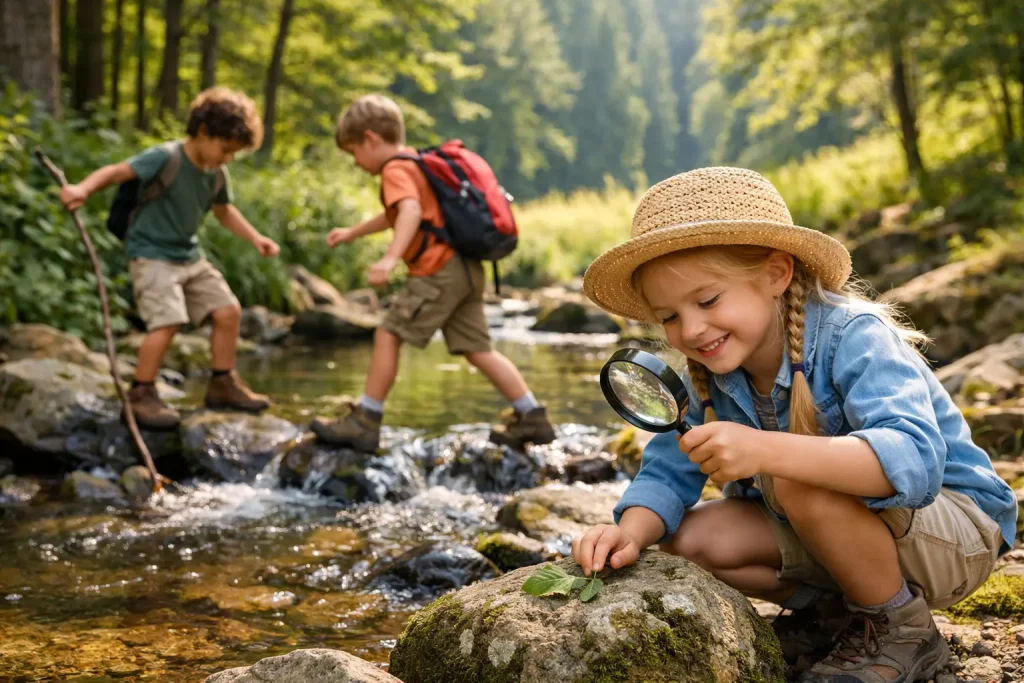
In a high-quality setting, a single theme can touch many areas of development at once. A garden exploration might begin with collecting leaves and noticing shapes. It can lead to counting, sorting by size, learning new vocabulary, drawing patterns, asking scientific questions and telling stories about what children found. Nothing feels forced, yet the learning is layered and memorable.
That is often what families value most in a premium early years environment. Children are not merely kept busy. They are known, guided and inspired. Their days hold beauty, movement, conversation, routine and discovery. In settings such as Alpine Preschool, where nature, trained teachers and a carefully structured pathway come together, play becomes something far more powerful than recreation. It becomes the way children flourish.
A play based curriculum guide is, at heart, a reminder to look beneath the surface. If the laughter is genuine, the teaching is skilled and the environment is thoughtfully prepared, play is not a softer option. It is often the wisest place for strong learning to begin.
The right early years experience should leave a child not only ready for school, but still full of wonder when they get there.