
A child lining up stones by size, inventing a story for a cardboard box, or negotiating whose turn comes next may not look as though they are doing “school work”. Yet these everyday moments are often where the deepest early learning begins. When parents ask how play based preschool supports learning, they are really asking a bigger question – how young children build the foundations they will carry into reading, writing, friendships, resilience, and later academic success.
For children aged 2 to 7, play is not a break from learning. It is one of the most natural and effective ways they make sense of the world. In a thoughtful preschool setting, play is not random or unstructured for the sake of it. It is carefully guided by trained teachers who understand child development, know when to step in, and know when to let curiosity lead.
How play based preschool supports learning in real life
Play-based learning works because it matches how young children develop. At this stage, children learn through movement, repetition, sensory experiences, conversation, and relationships. They need to touch, test, build, imagine, ask, and try again. Sitting still for long periods and memorising facts can have a place in small doses, but it rarely reaches the whole child.
In a strong play-based preschool programme, children are developing several skills at once. A water-play activity may include early maths as they compare volume, language as they describe what they notice, social skills as they share tools, and fine motor control as they pour and scoop. A pretend market may support early literacy, turn-taking, confidence, and problem-solving all in the same morning.
This is one reason many families are drawn to a more holistic early years environment. Children are not split into neat categories such as “academic” or “creative”. They are learning through connected experiences that reflect real life.
Play builds the foundations for academic learning
One common concern parents have is whether play-based preschool prepares children well enough for formal schooling. The short answer is yes, when it is done with intention. In fact, good play-based learning often strengthens the exact skills that later academic learning depends on.
Language grows quickly in playful settings. Children speak more freely when they are immersed in meaningful activities, whether they are acting out a story, exploring nature outdoors, or explaining how they built a tower. These conversations expand vocabulary, sentence structure, listening skills, and confidence in self-expression.
Early maths also develops naturally through play. Sorting leaves by shape, counting steps, spotting patterns in blocks, or measuring ingredients for a simple cooking activity all support number sense. Children begin to understand quantity, sequence, comparison, and spatial awareness before they are expected to complete formal written tasks.
Even early literacy is often stronger when it begins with play. Children who sing, rhyme, retell stories, recognise signs and labels, and engage in imaginative role play are building the pre-reading and pre-writing skills that matter most. Before a child writes neatly on a line, they need hand strength, control, attention, and the motivation to communicate. Play helps all of these develop.
Social and emotional growth cannot be separated from learning
A child may know their letters and numbers, but if they struggle to manage frustration, take turns, or feel secure away from home, learning becomes harder. This is why social and emotional development deserves just as much attention as early academics.
Play gives children repeated opportunities to practise these skills in a natural way. They learn how to join a group, cope when things do not go their way, express their ideas, and understand the feelings of others. There are plenty of small tensions in a preschool day – who had the red spade first, how to rebuild a collapsed den, what to do when a game changes. With caring teacher support, these moments become lessons in resilience and empathy.
This matters far beyond the preschool years. Children who feel safe, capable, and connected are more ready to engage, persist, and enjoy learning. Confidence does not appear overnight. It grows from many small experiences of being heard, encouraged, and trusted.
Why movement, nature, and sensory experiences matter
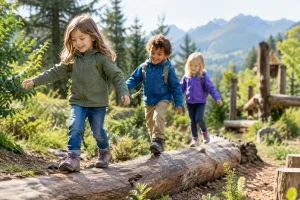
Young children are not designed to learn only at tables. They learn with their whole bodies. Running, balancing, digging, climbing, carrying, splashing, and exploring all contribute to cognitive growth as well as physical development.
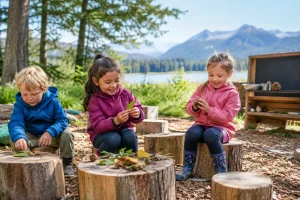
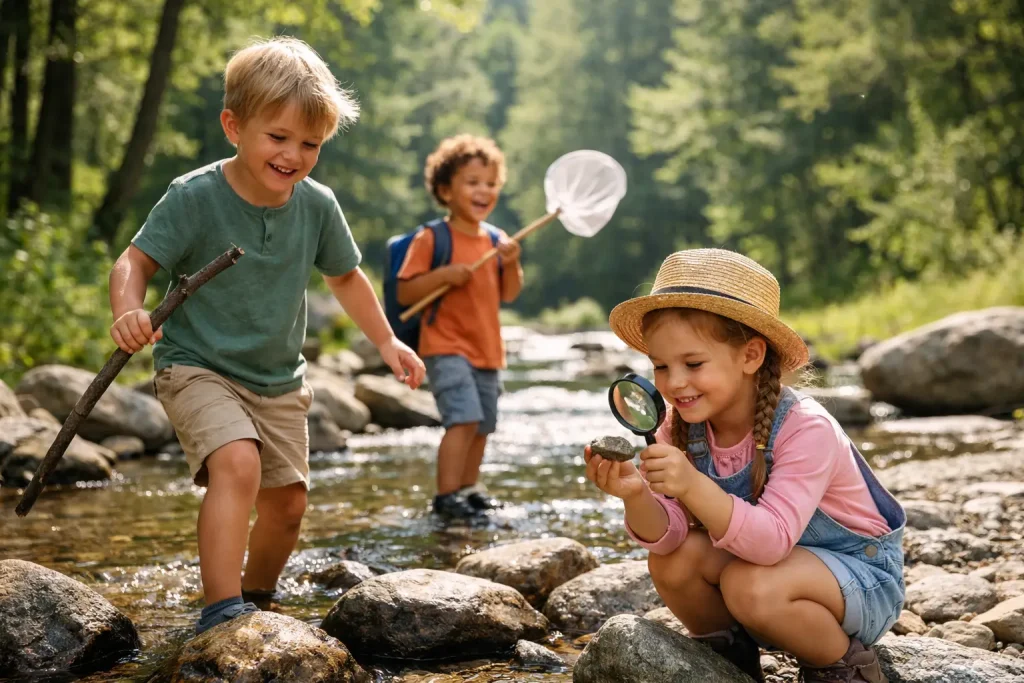
Outdoor learning is especially powerful because it adds space, variety, and wonder. A garden path can become a maths trail. Mud can become a science lesson. Watching insects, collecting seeds, and noticing weather changes can spark questions that no worksheet ever could. Nature also tends to calm children, support attention, and invite richer sensory learning.
This does not mean every moment outdoors is automatically educational. The quality comes from the environment and the adults within it. Trained teachers know how to turn a child’s fascination with leaves, puddles, or shadows into meaningful conversation and discovery. In a purpose-built setting with generous green space, children can explore more freely while still feeling safe and well guided.
What makes play-based learning effective, not just enjoyable
Not all play-based settings are equal. This is where parents need nuance. “Play-based” should not mean children are left to wander without purpose, nor should it mean academics are ignored until much later. The most effective programmes combine freedom with structure.
Teachers plan carefully around developmental milestones. They create invitations to learn, observe how each child responds, and extend experiences at the right moment. One child may need more sensory exploration before joining a group task. Another may be ready for more challenge in early phonics or pattern work. A well-designed curriculum makes room for both.
This balance is often what reassures families seeking high standards as well as warmth. Children benefit from a clear educational pathway, but they also need room to be children. A nurturing environment with strong teaching can hold both truths at once.
At Alpine Preschool, this balance sits at the heart of the experience. Structured stages, trained educators, outdoor classrooms, and a child-centred curriculum work together so children can flourish through creativity, curiosity, and purposeful play.
How play based preschool supports learning for different children
Every child arrives with a different temperament, pace, and set of strengths. Some leap into group activities. Others observe quietly before joining in. Some love words. Others think best through movement or making. One of the strengths of a play-based approach is that it can meet children where they are.
For a younger child, play may focus more on sensory exploration, routines, and separation confidence. For an older child, it may involve more complex collaboration, storytelling, early project work, and structured problem-solving. The learning is still intentional, but the pathway feels developmentally right rather than rushed.
There are trade-offs, of course. Parents who expect piles of worksheets or visible written output every day may initially feel uncertain. Play-based learning can look less “productive” from the outside. The results are often seen in language, independence, focus, and confidence before they appear in neat pages of completed work. That requires trust in the process and trust in the educators leading it.
What parents can look for in a play-based preschool
If you are considering a preschool, it helps to look beyond the phrase itself and pay attention to what daily learning really looks like. Ask how teachers support early literacy and maths through play. Notice whether children are engaged and purposeful. Observe whether the environment feels calm, inviting, and rich in possibilities.
It is also worth asking how the school uses outdoor space, how teachers track progress, and how the curriculum evolves across age groups. A premium early years setting should offer more than attractive classrooms. It should provide thoughtful progression, emotional security, and experiences that genuinely help children grow.
When this is done well, children do not simply pass time until “real school” starts. They build the habits and attitudes that make future learning stronger – curiosity, persistence, language, cooperation, self-belief, and delight in discovery.
The early years move quickly, but their impact lasts. A preschool that honours play while guiding development with skill gives children something deeply valuable: a start in learning that feels joyful, capable, and true to childhood.