

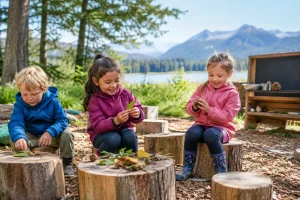
A four-year-old kneading mud into “cakes”, counting leaves for a pretend shop, and negotiating whose turn comes next may not look academic at first glance. Yet this is exactly where the conversation around play based learning vs worksheets becomes so important for parents of young children. What seems simple on the surface is often rich with language, problem-solving, self-control, creativity, and early mathematical thinking.
For families choosing a preschool, the real question is not whether children should ever hold a pencil or complete a task at a table. It is how young children learn best, and what kind of environment helps them grow with confidence rather than pressure. In the early years, that distinction matters a great deal.
Play based learning vs worksheets: what is the difference?
Play-based learning is not free-for-all play with no purpose. In a high-quality early years setting, it is carefully planned by trained teachers who understand child development. Children explore, build, sort, imagine, move, ask questions, and test ideas through hands-on experiences. The learning is real, but it is delivered in a way that matches how young children naturally develop.
Worksheets, by contrast, are usually paper-based tasks with one expected outcome. A child may trace letters, match pictures, circle the correct answer, or complete a number activity. These can look reassuringly academic to adults because the result is visible and easy to measure. A finished page can feel like proof of learning.
That is where the comparison can become misleading. A completed worksheet shows that a child has done the task. It does not always show deep understanding, curiosity, or whether the child can apply the skill in a real situation.
Why play often teaches more deeply in the early years
Young children learn through movement, repetition, sensory experience, and relationships. They are not simply absorbing facts. They are building the foundations that later support reading, writing, maths, concentration, and social confidence.
When a child pours water from one container to another, they are not “just playing”. They are exploring volume, control, prediction, and cause and effect. When they build a tower that keeps collapsing, they are testing balance, resilience, and problem-solving. When they retell a story through role play, they are developing memory, sequencing, language, and imagination.
This kind of learning tends to stay with a child because it is active and meaningful. It belongs to them. They have discovered something, not merely copied it.
There is also an emotional benefit. Children who learn through play are often more willing to take risks, try again, and stay engaged for longer. They connect learning with enjoyment and possibility. That love of learning is not a soft extra. It is one of the strongest foundations a school can help build.
Where worksheets can help – and where they fall short
Worksheets are not automatically harmful. Used sparingly and at the right stage, they can support certain goals. An older child who is ready for more formal tasks may benefit from short, well-designed paper activities that strengthen pencil control, letter recognition, or number recall. Some children also enjoy the sense of completion that comes from finishing a page.
The difficulty comes when worksheets become the main method of teaching young children. A child may trace the letter A several times without truly connecting it to sounds, words, or meaning. They may count pictures on a page but struggle to count real objects during play. They may complete tasks correctly while feeling bored, anxious, or disconnected.
Worksheets can also narrow the learning experience. They rarely invite much movement, collaboration, imagination, or open-ended thinking. For children aged two to seven, those elements are not distractions from learning. They are central to it.
Play based learning vs worksheets for school readiness
Many parents understandably worry about school readiness. They want their child to feel prepared, capable, and confident when formal schooling begins. Because of that, worksheets can seem like the safer route. They look closer to what “real school” might involve.
But school readiness is much broader than recognising letters and numbers on paper. A ready child can listen, express needs, manage emotions, follow routines, solve small problems, and work with others. They can persist when something feels difficult. They are curious enough to engage and confident enough to try.
These qualities are developed powerfully through play-based experiences. A child who spends time in well-planned play learns to wait, share, negotiate, lead, follow, and recover from frustration. They strengthen fine motor control through threading, painting, clay, climbing, pouring, and construction before being asked to write extensively. They build spoken language through songs, stories, conversations, and pretend play before being expected to read with understanding.
Formal academic skills still matter, of course. The healthiest early years approach is not play instead of learning. It is play as the pathway into learning, with carefully introduced structure as children are developmentally ready.
Why the quality of teaching matters more than the format alone
Not all play-based settings are equal, and not all worksheet-based classrooms are rigid. The real difference often lies in the quality of the teaching. Thoughtful educators observe each child, understand what they are ready for, and create experiences that stretch learning gently and purposefully.
A strong play-based classroom has clear intentions. Teachers know when to step in with new vocabulary, when to ask a question, when to model a skill, and when to let a child wrestle with an idea independently. It feels warm and joyful, but it is not accidental.
That matters for parents to remember. If a setting says it offers play-based learning, it should still be able to explain how children develop early literacy, mathematical thinking, concentration, and independence. Play is most powerful when it is guided by expertise.
What this looks like in real life
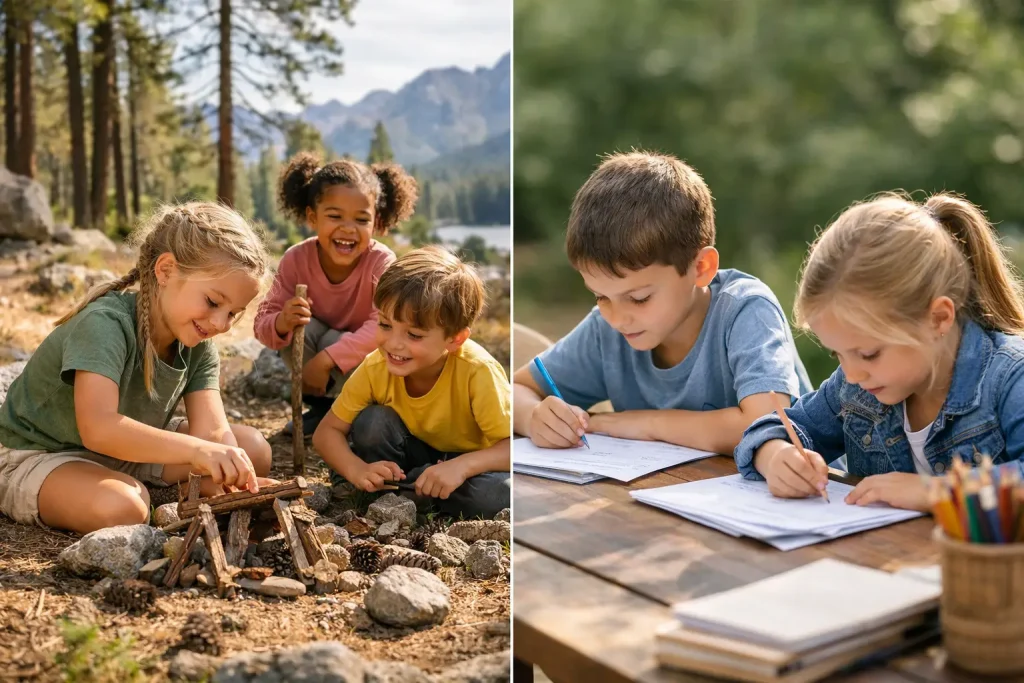
Imagine two children learning about patterns. One is given a worksheet with rows of shapes to complete. The other is invited to create patterns with pinecones, shells, leaves, and coloured blocks, then talk about what comes next.
The worksheet may check whether the child can identify the correct answer. The hands-on activity develops the same concept while also building language, sensory awareness, attention, and creativity. It allows the child to manipulate ideas physically and explain their thinking.
The same is true with early writing. Before children write confidently, they need shoulder strength, hand control, finger coordination, posture, and visual tracking. Outdoor play, loose parts, painting on easels, scooping sand, using tongs, and moulding dough all support writing readiness. A worksheet may practise the final skill, but play often develops the abilities that make that skill possible.
What parents should look for in an early years setting
If you are comparing preschools, it helps to look beyond displays of completed work. Ask how children spend their day. Notice whether there is room for movement, nature, exploration, conversation, and sensory learning alongside guided tasks.
Ask how teachers support literacy and numeracy through daily experiences. Ask how they help children build confidence, kindness, and independence. Ask how the environment encourages curiosity rather than rushing children towards performance.
In a thoughtfully designed preschool, you should be able to see both warmth and structure. Children should feel safe enough to explore and supported enough to progress. That balance is where real growth happens. At Alpine Preschool, for example, this balance is shaped through trained teachers, purposeful outdoor learning, and a curriculum that respects both developmental milestones and the joy of childhood.
So which is better?
For most young children, play-based learning offers the stronger foundation. It reflects how children naturally learn and supports the whole child – socially, emotionally, physically, and cognitively. It does not ignore academic development. It builds the conditions that make academic development more meaningful and sustainable.
Worksheets can have a place, especially for older children who are ready for short, focused tasks. But they work best as a small part of a richer learning experience, not as the centre of it.
When children are given space to imagine, investigate, move, create, and connect, they are not being kept from learning. They are being invited into it in the way that suits early childhood best. And for parents, that can be a reassuring thought: the muddy hands, the role-play conversations, the block towers, and the outdoor discoveries are not distractions from the future. They are part of how children grow into it.