


Choosing a preschool often starts with a feeling. You walk into a classroom, watch how the teachers speak to the children, notice whether the space feels calm or rushed, and imagine your child there. Yet alongside that instinctive response, most parents want something more concrete too – a clear guide to early years curriculum that explains what children are actually learning, how they are supported, and why those first school years matter so much.
For children aged 2 to 7, a strong early years curriculum should do far more than fill the day with activities. It should create a thoughtful pathway for growth – building language, confidence, coordination, social understanding, early thinking skills, and a genuine love of learning. The best programmes do this in a way that feels joyful and age-appropriate, not pressured.
What is an early years curriculum?
An early years curriculum is the planned framework that shapes a child’s learning during the preschool and kindergarten years. It guides what children experience, what skills they begin to develop, and how teachers support progress over time.
That may sound formal, but in practice it should feel very natural. Young children do not learn best through long explanations or repetitive worksheets. They learn through movement, conversation, stories, music, imaginative play, hands-on discovery, and warm relationships with trusted adults. A well-designed curriculum organises those experiences so that they build meaningfully from one stage to the next.
This is where many parents understandably have questions. If a setting is play-based, will my child still be ready for primary school? If it is more structured, will there still be room for curiosity and creativity? The honest answer is that balance matters. The strongest early years programmes combine clear developmental goals with plenty of space for exploration.
A guide to early years curriculum by stage
Children develop quickly in the early years, but not always evenly. One child may speak confidently but need help with turn-taking. Another may be physically adventurous yet slower to warm to group activities. That is why a good curriculum should be staged, with each phase meeting children where they are and gently extending them.
Ages 2 to 3 – learning readiness begins
At this age, the curriculum should focus on security, routine, language exposure, sensory experiences, and social confidence. Children are learning how to separate from parents, follow simple rhythms of the day, express needs, and begin joining shared activities.
This stage often looks deceptively simple. Water play, songs, nature walks, story time, sand trays, building blocks, and guided free play may not resemble formal teaching, but they are laying essential foundations. Through these experiences, children develop listening, vocabulary, fine motor control, body awareness, and the confidence to explore.
A curriculum that rushes into academic tasks too early can miss what children most need. Before a child can write meaningfully, for instance, they need hand strength, posture, coordination, and ideas to communicate.
Ages 3 to 4 – expanding language and thinking
As children settle into nursery learning, the curriculum should begin offering more structure while keeping lessons active and playful. This is often the stage where parents notice rapid growth in communication, independence, and curiosity.
Children start making stronger connections between ideas. They classify objects, ask more complex questions, join longer stories, and begin understanding patterns, numbers, and early problem-solving. They also grow socially, learning to cooperate, negotiate, and manage emotions with support.
At this stage, teachers play a crucial role. A thoughtful question, a carefully prepared activity, or a shared outdoor investigation can stretch a child’s thinking far more effectively than simply giving the right answer.
Ages 4 to 5 – building foundations for formal learning
In the kindergarten years, children are usually ready for more intentional pre-literacy and early numeracy work. That does not mean replacing play with desk-based routines. It means using developmentally appropriate methods to build stronger foundations.
Children may begin recognising letter sounds, hearing rhyme, tracing shapes with control, counting with meaning, sorting quantities, and following multi-step instructions. They are also learning to persist with tasks, work collaboratively, and take pride in completing something independently.
A good curriculum at this stage blends cognitive growth with emotional readiness. School readiness is not only about letters and numbers. It is also about resilience, concentration, self-help skills, and the confidence to participate.
Ages 5 to 7 – deepening independence and applied learning
For older children in the early years pathway, the curriculum should strengthen academic foundations while protecting the qualities that make learning meaningful – curiosity, creativity, confidence, and connection.
Children become more capable of linking ideas across subjects, expressing themselves with greater detail, and handling more structured learning experiences. They may engage in early writing, practical mathematics, science-based exploration, creative projects, and collaborative tasks that require reasoning and communication.
Even here, it helps to avoid false choices. Children do not need to pick between academic preparation and joyful learning. They need both.
What should a strong early years curriculum include?
Parents do not need to memorise educational jargon to recognise quality. In most cases, a strong curriculum is visible in the daily life of the school.
Language-rich teaching is one of the clearest signs. Children should be surrounded by conversation, stories, songs, questions, and opportunities to express themselves. The early years are a powerful period for communication development, and this affects everything from social confidence to future reading.
Another essential element is purposeful play. This is not the same as leaving children to fill time on their own. Purposeful play is carefully supported by educators who observe, extend ideas, and create meaningful experiences. A role-play corner can build language and social skills. Outdoor construction can develop planning, teamwork, and motor strength. Nature exploration can support observation, vocabulary, and scientific thinking.
Physical development matters just as much. Running, climbing, balancing, threading, drawing, cutting, and manipulating small objects are all part of learning. Children who move well often settle better, focus longer, and feel more confident in their environment.
Emotional and social growth should also sit at the heart of the curriculum. Young children need help recognising feelings, building friendships, managing disappointment, sharing attention, and feeling safe enough to try new things. These are not extras. They are core learning.
Why outdoor learning deserves a place in the curriculum
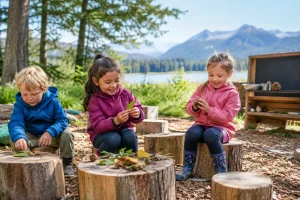
For many families, outdoor space is seen as a bonus. In truth, it can be a central part of an excellent early years curriculum. When children learn outdoors, they engage their senses more fully, move more freely, and experience the world in ways that indoor classrooms alone cannot offer.
A garden, nature trail, water area, or open play space can support language, science, mathematics, creativity, and self-regulation all at once. Children compare leaf shapes, count natural objects, test ideas with sand and water, observe insects, invent stories, and strengthen their bodies through active play.
Outdoor learning also offers something less measurable but deeply valuable – wonder. Childhood should include room for mud, sunlight, birdsong, texture, movement, and discovery. In a premium early years setting, these experiences are not treated as occasional extras but as part of a well-considered curriculum.
How teachers bring the curriculum to life
Even the best curriculum on paper depends on the adults delivering it. Trained, attentive teachers make the difference between a classroom that simply stays busy and one where children genuinely flourish.
Good educators observe closely. They notice when a child is ready for more challenge, when another needs reassurance, and when an unexpected moment can become a meaningful lesson. They understand that progress is not always linear. Some children leap ahead in certain areas and take longer in others, and that is perfectly normal.
For parents, this means looking beyond displays and lesson plans. Ask how teachers track development, how they respond to individual needs, and how they balance structured learning with child-led exploration. A warm, skilled teaching team is often the clearest sign that the curriculum is being delivered with care and expertise.
How to tell if a curriculum is right for your child
There is no single perfect model for every child. Some children thrive immediately in lively group settings, while others need a gentler start. Some love imaginative play, while others prefer building, movement, or sensory discovery. A good school recognises these differences without losing its educational direction.
As a parent, it helps to ask simple but revealing questions. Does the curriculum feel age-appropriate? Is there a clear developmental pathway from one stage to the next? Are children encouraged to think, speak, move, create, and explore? Is school readiness understood broadly, rather than reduced to academic drilling?
If you visit a setting and see children who are engaged, secure, curious, and confidently interacting with teachers, that tells you a great deal. In places such as Alpine Preschool, where structured learning is paired with nature-connected experiences and a nurturing environment, families often find the balance they are seeking – one that supports both academic foundations and the magic of childhood.
The right early years curriculum should leave children with more than a set of skills. It should help them feel capable, valued, and eager to come back tomorrow, ready for whatever they will discover next.