



A child who knows what comes next can give more attention to what matters now. When morning greetings lead into purposeful play, stories, movement, outdoor discovery and gentle reflection, young children feel secure enough to be curious. That is where structured preschool curriculum benefits become most visible: not in children sitting still for longer, but in their growing confidence to explore, communicate and try again.
For parents considering a preschool, the word “structured” can raise an understandable question. Will there still be room for play, imagination and the wonderfully unpredictable interests of early childhood? A thoughtful curriculum should offer both. It provides a clear developmental pathway while leaving generous space for children to investigate, create, move and learn through real experiences.
What a structured preschool curriculum really means
A structured curriculum is not a timetable packed with worksheets or a race towards primary school. It is a carefully planned approach that gives each age group meaningful experiences suited to its stage of development. Teachers understand what children are ready to practise next, then create inviting ways for them to build those skills.
For a two-year-old, this may mean learning to separate from a parent, join a short group activity, use simple language to express a need and explore materials safely. For an older kindergarten child, it may involve extending concentration, recognising patterns, sharing ideas, listening to instructions and using early literacy and numeracy with purpose.
The structure sits behind the day rather than overshadowing it. Children may be planting seeds, building a bridge from loose parts, mixing colours or acting out a favourite story. A trained teacher sees more than the activity itself. They notice hand strength, vocabulary, turn-taking, problem-solving, confidence and the next small step that can help each child progress.
Structured preschool curriculum benefits for everyday confidence
Predictable routines create emotional security
Young children thrive when their day has a familiar rhythm. Knowing that there is time to arrive, play, eat, rest, learn outdoors and come together as a group helps them settle. This consistency is especially valuable during the first years away from home, when new faces and expectations can feel very big.
A routine does not need to be inflexible. A sudden rain shower might turn an outdoor plan into a puddle investigation, while a child’s fascination with insects may inspire a longer project. The reassuring framework remains, giving children a sense of safety even when the learning takes an unexpected direction.
As children begin to manage transitions, pack away materials, choose an activity and return to a task, they develop independence. These small daily achievements often carry into home life too. The child who can wait for a turn, put on a shoe with encouragement or explain what they need is building lasting self-belief.
Play becomes purposeful without losing its magic
Play is how young children make sense of the world. A well-designed curriculum protects time for it while ensuring that play experiences are rich, varied and developmentally meaningful. In a role-play café, children may practise conversation, counting, mark-making and cooperation. At a water station, they can compare volume, test ideas and discover new words such as full, empty, floating and sinking.
This is different from leaving children to entertain themselves with the same toys every day. Teachers prepare environments with a clear intention, observe closely and respond with thoughtful questions. “What do you think will happen if we add another block?” can stretch a child’s thinking far more effectively than supplying the answer.
The right balance matters. Some children need time to enter play slowly, while others benefit from guidance that helps them deepen an idea rather than move rapidly from one activity to another. Structure enables teachers to plan for both needs.
Skills develop in a natural sequence
Early learning is cumulative. Before children can confidently write, they need strong shoulders, hands and fingers, visual awareness and the desire to make marks. Before they can solve number problems, they need opportunities to sort, compare, count and notice patterns in everyday life.
A staged preschool programme makes these foundations visible. Rather than expecting all children to reach the same outcome at the same moment, it offers a progression that respects developmental readiness. Children revisit key ideas in increasingly complex ways, gaining mastery through repetition, variation and encouragement.
This approach supports cognitive development while recognising that academic readiness is only one part of being ready for school. Children also need to ask for help, cope with disappointment, listen to others and persist when something feels difficult. These are not extras. They shape how confidently a child can participate in future learning.
Why outdoor learning belongs in the structure
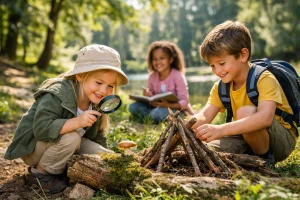
A purposeful curriculum should not be confined to four walls. Outdoor classrooms give children space to use their whole bodies, follow their curiosity and encounter the changing details of the natural world. A fallen leaf, a trail of ants or the texture of damp soil can become a starting point for language, science, creative expression and care for living things.
Nature-connected learning also brings a welcome variety of sensory experiences. Children balance on uneven surfaces, carry materials, listen for birds, notice shadows and feel the difference between rough bark and smooth stones. These experiences support coordination and sensory awareness in ways that are difficult to reproduce at a table.
At the same time, outdoor learning needs intention. Safe boundaries, appropriate supervision and activities matched to children’s abilities allow freedom to feel joyful rather than chaotic. Purpose-built green spaces can offer room for energetic movement, quiet observation and collaborative projects, all within a secure daily rhythm.
Social growth needs guidance, not guesswork
Preschool is often a child’s first regular community beyond family. Sharing space with others brings wonderful opportunities, as well as disagreement over a spade, a puzzle piece or a place in the game. A structured environment gives children repeated chances to practise social skills with patient adult support.
Teachers can model kind language, help children name feelings and guide them towards solutions. Over time, children learn that another person may have a different idea, that feelings can be managed and that they can repair a friendship after a difficult moment. Cultural diversity within the classroom adds another layer of learning, helping children meet difference with interest and respect.
These skills cannot be rushed or taught through a single lesson. They grow through everyday moments: welcoming a friend, taking turns on a bicycle, working together on a construction project and listening during a shared story.
How parents can recognise a meaningful programme
When visiting a preschool, look beyond whether the room appears busy or the displays look polished. Ask how teachers plan for different developmental stages and how they observe each child’s progress. Listen for an approach that values communication between home and school, because parents offer essential insight into a child’s interests, routines and wellbeing.
It is also helpful to ask how play, early academic learning and outdoor experiences work together. A strong answer should show that these are not competing priorities. They are connected parts of a whole-child education.
At Alpine Preschool, this journey is designed across Playgroup, Nursery, Kindergarten 1 and Kindergarten 2, so children can move forward with continuity as their confidence and capabilities grow. The aim is not to make childhood feel older than it is. It is to make each stage rich enough to prepare children for the next one.
A structured programme may suit many children, but the quality of the structure is what matters. If it is too rigid, children can lose the time and agency that make learning meaningful. If it is too loose, important developmental opportunities may be missed. The most nurturing settings hold both a clear educational purpose and genuine respect for each child’s pace.
When choosing an early years environment, picture your child arriving each morning. Look for a place where they are known, where their questions are welcomed and where the day has enough rhythm to feel safe and enough possibility to feel magical. That combination gives children a steady place from which to grow bravely.