
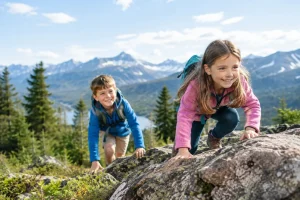
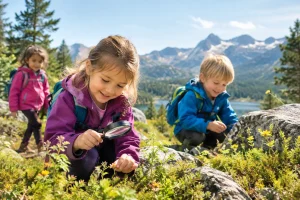

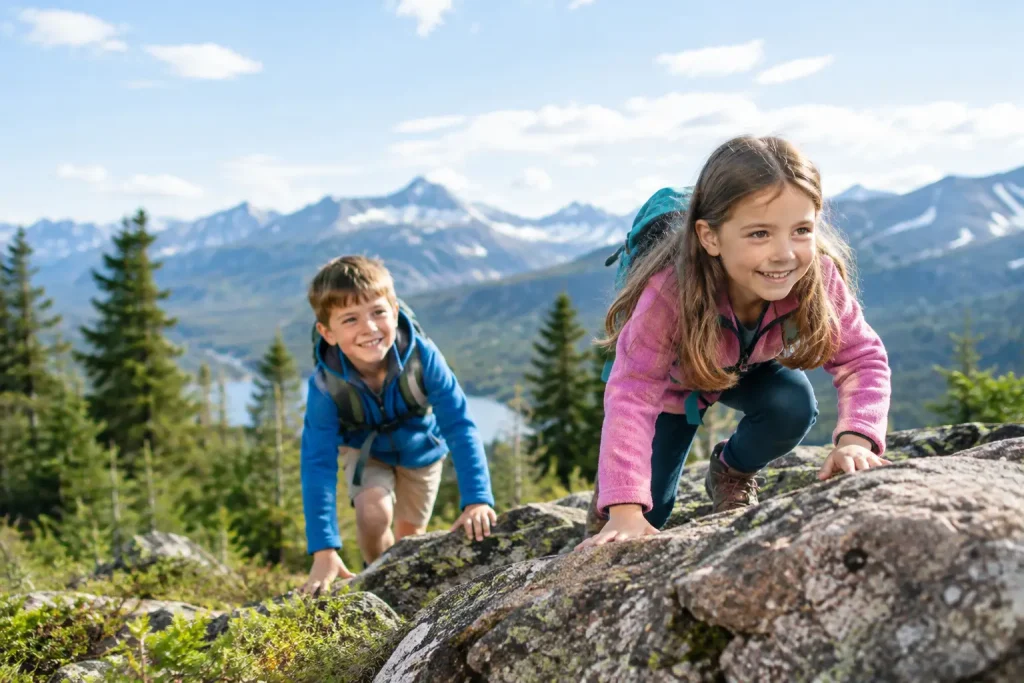
A child balancing along a low log, deciding whether to step across a puddle, or working out how to climb down from a boulder is doing far more than playing. They are testing their body, reading their surroundings and learning, little by little, that they can meet a challenge. This guide to outdoor risk play explains why these meaningful moments matter and how they can be offered with thoughtful adult support.
For many parents, the word ‘risk’ naturally brings safety to mind. It should. Young children need attentive adults, suitable spaces and clear boundaries. Yet removing every uncertainty can also remove valuable opportunities to practise judgement, persistence and self-belief. The aim is not danger. It is the carefully considered challenge that helps a child flourish.
What outdoor risk play really means
Outdoor risk play is play that includes manageable uncertainty. A child may climb, move at speed, use real tools with close supervision, explore uneven ground or play near natural elements such as mud, water and sticks. The challenge feels real to the child, but it is appropriate for their age, capabilities and the environment.
Risk is different from a hazard. A risk is a challenge a child can notice and learn to navigate, such as judging where to place their feet on a slope. A hazard is a hidden or unacceptable source of harm, such as broken equipment, a loose sharp object or a climbing surface that has not been properly checked. Skilled early years educators remove hazards while preserving healthy risk.
This distinction allows children to have rich, memorable experiences without treating the outdoors as something to fear. It also recognises that children do not all need the same level of challenge. One child may be ready to jump between stepping stones, while another may first need to hold an adult’s hand and try a single step.
Why challenge belongs in early childhood
Children aged two to seven are constantly building an understanding of what their bodies can do. When they climb, carry, dig, balance and navigate natural spaces, they strengthen coordination, spatial awareness and physical confidence. These are practical foundations for everyday independence, from managing stairs to joining in confidently with peers.
The emotional learning is just as powerful. A child who pauses at the top of a climbing frame and chooses a safe route down is practising decision-making. A child whose den falls down and decides to rebuild is developing perseverance. A child who feels nervous, tries anyway and succeeds experiences a well-earned sense of pride.
Outdoor challenge can also support social development. Children often negotiate turns, create shared rules and help one another when building with loose parts or tackling an obstacle route. In these moments, they learn that confidence does not always mean being the fastest or bravest person in the group. It can mean asking for help, waiting patiently or saying, ‘I am not ready yet.’
There is a balance to strike. Constantly encouraging a child to go higher or faster can create pressure, particularly for cautious children. Equally, stepping in too quickly can communicate that they are incapable. The most supportive approach is to notice, stay close and let the child lead where possible.
A guide to outdoor risk play by age and stage
At Playgroup and Nursery age, risk play is often close to the ground and deeply sensory. Children may walk over grass, gentle slopes or textured paths; pour water; carry small buckets; roll down a grassy bank; and balance on wide, low surfaces. Their learning comes through repetition and the joy of discovering how movement feels.
As children move through Kindergarten 1, they may be ready for more complex climbing, den-building, tool use such as supervised child-safe hand drills or peelers, and imaginative play using branches, fabric and natural materials. They begin to make clearer plans: where a bridge should go, how a shelter will stand, or which route is easiest across the garden.
By Kindergarten 2, many children can take greater responsibility within carefully set limits. They can assess whether equipment is stable, explain a safety rule to a friend and adapt when a plan does not work. This does not mean every older child should take the same risks. Development is individual, and a confident choice to observe is also a valid part of learning.
What thoughtful adult supervision looks like
Good supervision is active, not restrictive. It begins before play starts, with adults checking the area, considering weather conditions and preparing materials that are safe, well maintained and suitable for the group. It continues through close observation, positioning adults where they can support children promptly without interrupting every attempt.
The language adults use matters. Rather than saying, ‘Be careful’, which is too vague to guide a child, try specific prompts: ‘Can you see where your next foot will go?’ ‘Does that branch feel strong enough?’ or ‘What could help you come down safely?’ These questions help children scan, think and make decisions for themselves.
At times, an adult will need to set a firm boundary. A surface may be too slippery after heavy rain, a child may be overly tired, or a game may become too crowded to manage safely. Boundaries are not a failure of adventurous play. They are part of teaching children that responsible choices change with the conditions.
Trained educators also know when to offer encouragement and when to give space. A child working hard to climb a low structure may need a calm presence nearby rather than a hand pulling them upwards. If they ask for help, it can be offered in a way that keeps the child involved: ‘I will steady this for you while you find your footing.’
Bringing healthy risk play into family life
Parents do not need a large garden or specialist equipment to give children meaningful outdoor challenges. A walk in the park can become an invitation to balance along a kerb away from traffic, step over roots, collect fallen leaves or choose the driest path after rain. The setting must always be checked first, and children should remain within close supervision, but everyday outdoor spaces offer plenty to investigate.
At home, simple materials can create open-ended play. A few large cardboard boxes, cushions, safe containers, ropes used with adult guidance, or a patch of soil for digging can invite children to plan and problem-solve. Choose challenges that allow a child to succeed after effort, rather than tasks that are beyond their current physical control.
Try to make room for untidy, slower play too. Muddy hands, damp trousers and a pile of sticks can be signs that a child has been fully absorbed in meaningful learning. Practical clothing, a change of clothes and a calm approach to mess make these experiences easier for everyone.
It can help to reflect after play rather than focusing only on the outcome. Ask, ‘What felt tricky?’ ‘How did you solve that?’ or ‘What would you do differently next time?’ Such conversations show children that trying, reassessing and learning are more valuable than getting everything right immediately.
How a quality preschool manages risk and safety
For families choosing an early years setting, outdoor provision should feel inspiring and well managed at the same time. Look for a campus where outdoor areas are designed with different ages in mind, equipment is checked routinely and children have access to natural, varied spaces rather than one fixed activity alone.
Ask how teachers assess activities, how they respond to changing weather and how they communicate boundaries to children. A strong programme will be able to explain its approach clearly: children are encouraged to explore, but educators remain attentive, trained and purposeful. Outdoor learning should not be treated as extra playtime. It is part of a carefully planned developmental experience.
At Alpine Preschool, outdoor classrooms and expansive green spaces create opportunities for children to explore with curiosity while trained teachers guide each experience with care. Whether children are building, climbing, investigating or collaborating, the intention is to help them feel capable in a setting designed for discovery.
The best outdoor risk play does not ask children to be fearless. It gives them the time, trust and gentle support to discover what they can do, one thoughtful challenge at a time.