
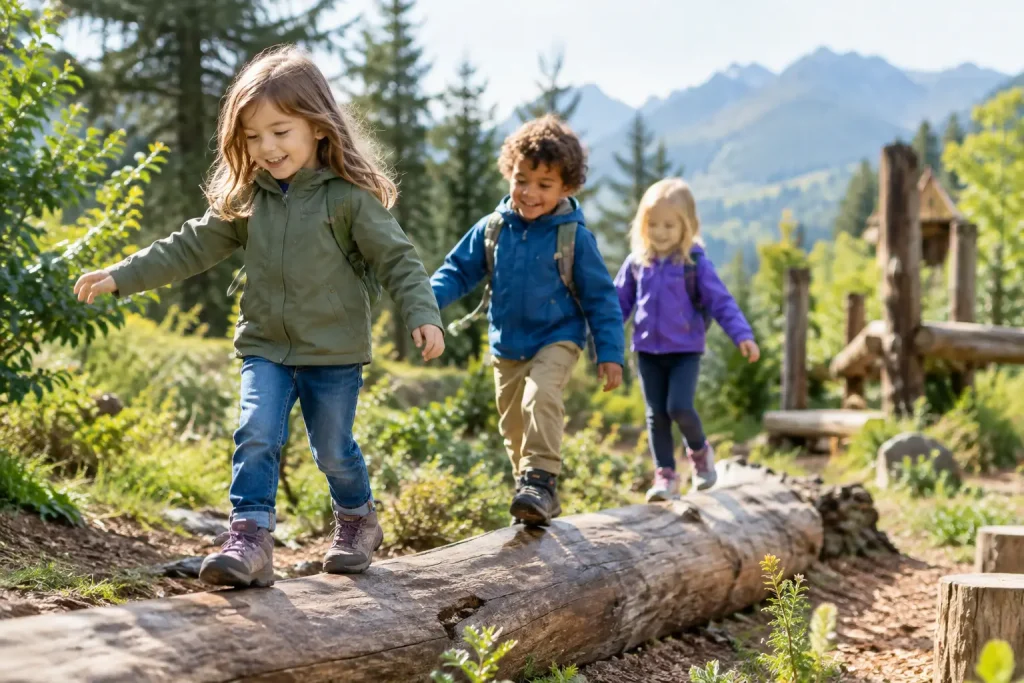
A child carrying a watering can, balancing across a low timber beam, or pausing to watch an ant has not stepped away from learning. They are deeply involved in it. Thoughtful preschool outdoor space design gives children aged 2 to 7 a setting where curiosity has room to grow, bodies can move freely, and everyday discoveries become meaningful learning moments.
For parents, a beautiful outdoor area is reassuring. Yet its greatest value is not simply that it looks inviting. It is how the space supports independence, friendships, sensory development, language, problem-solving and joyful confidence – all while children experience the changing textures, sounds and rhythms of nature.
Why outdoor spaces matter in the early years
Young children learn through their whole bodies. Before they can describe balance, they feel it while stepping from one surface to another. Before they understand growth, they notice a seedling they planted has new leaves. Outdoor play turns ideas into experiences children can remember.
A well-planned environment also offers a healthy counterpoint to the indoor classroom. Indoors may be ideal for focused stories, creative work and small-group activities. Outside, children have more freedom to run, carry, climb, negotiate and explore. Both settings matter. The most enriching preschool days move naturally between them.
Nature-connected learning is especially valuable because it does not demand a performance from children. A puddle can invite jumping, measuring, imaginative play or a calm moment of observation. One child may investigate how water travels through a channel, while another creates a café from leaves and stones. The same space can meet different developmental needs without making any child feel left behind.
Preschool outdoor space design begins with purpose
The strongest outdoor classrooms are not built around a single impressive play structure. They are designed around the question: what experiences should children have here?
For younger children, the answer often includes secure, low-level exploration. They need clear boundaries, soft or stable surfaces, easy-to-reach materials and spaces where caring adults can remain close while allowing safe independence. For older preschoolers, challenge becomes increasingly important. They benefit from opportunities to test their strength, take measured risks, collaborate and persevere when something is difficult.
This does not mean every area must be busy or brightly filled. In fact, too much equipment can limit imagination. A few carefully chosen features, combined with loose natural materials such as logs, stones, sand, seed pods and fabric, can encourage children to invent their own possibilities.
Movement and physical confidence
Children need daily chances to use their large muscles. A thoughtful movement zone might include gentle slopes, stepping logs, balance beams, tunnels, open grass and climbing elements suited to different ages. These features help children develop coordination, spatial awareness and confidence in what their bodies can do.
The right level of challenge matters. A course that is too simple can quickly lose its appeal; one that is too demanding may discourage a hesitant child. Flexible spaces work best because teachers can adapt the activity. A set of timber rounds may become a quiet balancing path for one group and an imaginative river crossing for another.
Sensory discovery without overload
The outdoors naturally offers rich sensory learning: warm sunlight, cool shade, rough bark, fragrant herbs, birdsong and the feeling of soil between small fingers. These experiences help children make sense of their world and can be particularly calming after periods of concentrated indoor learning.
Sensory design should be considered rather than accidental. A planting area with herbs and flowers offers scent and colour. Sand and water play support pouring, filling, mixing and early scientific thinking. A shaded nook with natural textures provides a gentler option for children who need quiet. The aim is variety, not constant stimulation.
Spaces for imagination and connection
Some of the most valuable outdoor learning happens in areas that adults may initially see as simple. A small garden shelter, a mud kitchen, a collection of crates or a cluster of shrubs can become a home, a shop, a forest camp or a dinosaur habitat.
Imaginative play helps children practise language, empathy and social negotiation. When children decide who will cook, build or care for the pretend baby, they are learning to listen, express their ideas and make room for others. These are essential foundations for a kind, connected school community.
Safety and freedom should work together
Parents understandably want to know that outdoor learning is carefully managed. A nurturing environment does not remove every challenge. It makes challenge appropriate, visible and supported by trained adults.
Good design starts with practical essentials: secure boundaries, clear sightlines, age-appropriate equipment, dependable surfacing, shade, drainage and regular checks for wear or hazards. Materials should be durable and suitable for young children, while plants need to be selected with care. Storage also matters, as accessible but well-organised resources help teachers set up purposeful activities without creating clutter.
Supervision is just as important as the physical layout. Educators should be able to observe children across active and quieter zones, step in when needed and know when to give a child time to work something out independently. This balance builds trust. Children learn that adults are nearby, while also discovering that they are capable.
Weather planning deserves attention too. In Johor Bahru, shaded areas, drinking water and covered spaces make outdoor learning more comfortable in warm conditions. Rain need not end the experience altogether. With sensible planning, a sheltered veranda or covered outdoor classroom can turn the sound of rainfall into part of the day’s learning.
Make nature part of the curriculum, not just the view
A lawn beside a classroom is pleasant. An outdoor environment connected to daily learning is transformative. Teachers can use gardens, natural materials and seasonal changes to extend children’s interests in purposeful ways.
A gardening project may begin with children choosing seeds, then lead to counting pots, drawing plant changes, discussing what living things need and sharing responsibility for watering. A nature walk can inspire new vocabulary, storytelling, sorting or artwork. Water play can introduce early ideas about volume, cause and effect, and cooperation.
These experiences do not replace foundational learning. They give it context. When children count pebbles for a pretend café or use marks to label their garden plot, early literacy and numeracy feel relevant because they are part of something real.
At Alpine Preschool, expansive green spaces and outdoor classrooms are designed to support this kind of connected learning. Children are invited to explore with their hands, hearts and minds, supported by educators who recognise that meaningful play has clear developmental value.
What parents should look for during a school visit
When visiting a preschool, look beyond the newest equipment. Notice whether children appear engaged and comfortable. Are there places to move energetically, create quietly and rest in the shade? Can children reach materials for themselves? Do educators speak about outdoor time as a planned part of learning rather than a break from it?
It is also useful to ask how the school adapts the space for different ages. A two-year-old and a six-year-old need different kinds of challenge, even when they share a love of climbing, digging and imaginative play. Ask how safety checks are carried out, how children are supported in warm or wet weather, and how teachers use observations from outdoor play to guide the next steps in learning.
The answers reveal whether the outdoor area is simply an attractive feature or a living part of the school’s educational approach.
A truly special outdoor space does not need to entertain children every minute. It gives them time, room and gentle encouragement to notice, try, wonder and return to an idea tomorrow. In those unhurried moments, children often discover not only more about the world around them, but also more about themselves.