



A child proudly pouring water into a cup, asking “why?” for the tenth time, or waiting for a turn on the climbing frame may not look like a formal lesson. Yet these small moments reveal meaningful growth. This guide to nursery learning milestones helps parents recognise the skills children commonly develop during their nursery years, and understand how thoughtful early education supports them without rushing childhood.
Nursery learning is not about getting every child to the same point at the same time. It is about giving each child the confidence, language, relationships and experiences that help them flourish. Some children speak in detailed stories early on; others communicate most clearly through movement, play or careful observation. A milestone is best understood as a helpful signpost, not a pass-or-fail test.
What nursery learning milestones really mean
The nursery years are a period of remarkable change. Children are learning how to be part of a group, make sense of feelings, use language purposefully and explore ideas with growing independence. These areas overlap constantly. A child building a den outdoors, for example, may be negotiating with friends, testing balance, counting sticks and persevering when a wall falls down.
This is why high-quality nursery education looks beyond worksheets and early academic drills. Children need repeated opportunities to touch, move, imagine, talk, create and try again. Play gives teachers a rich view of what children understand and what support will help them take their next step.
Development is rarely neat or linear. A child may confidently recognise numbers but need more time to join group conversations. Another may be physically adventurous while still learning to manage separation at drop-off. Temperament, home language, previous experiences and simple developmental timing all matter. The aim is steady, supported progress rather than comparison.
A guide to nursery learning milestones by area
Social and emotional growth
One of the most valuable nursery milestones is learning to feel secure away from home. Children gradually become comfortable with familiar routines, trusted adults and other children. They begin to share attention with a teacher, take part in small-group activities and understand that a parent will return at the end of the session.
Over time, many children become better able to name simple feelings such as happy, sad, cross or worried. They may start using words to ask for help rather than reacting physically when frustrated. Taking turns, sharing materials and coping with a friend choosing a different game are all significant achievements, even when they require gentle adult support.
Independence also grows here. Putting on shoes, washing hands, opening a lunch box or helping to tidy up tells a child, “I can contribute.” These routines build pride as well as practical capability. Children do not need to complete every task perfectly. Encouragement, time and the chance to try are what matter most.
Communication and early language
Language develops through warm, responsive conversation. In nursery, children learn to listen to short instructions, respond to questions, join songs and rhymes, and use new vocabulary as they play. They begin to describe what they see, retell familiar events and express preferences: “I want the blue paint” or “I made a bridge for the cars.”
Story time is particularly powerful when it is active and joyful. Predictable refrains invite children to join in, while pictures and props help them understand new words. Rhymes, alliteration and sound games lay important foundations for later reading, but there is no need to turn every moment into a lesson. A child who enjoys language is more likely to use it confidently.
For bilingual and multilingual children, it is natural for language development to unfold across more than one language. A child may understand one language before speaking it freely, or blend words from both languages while communicating. Families can support this by continuing to use the language that feels most natural and emotionally rich at home.
Thinking, curiosity and early maths
Nursery children are natural investigators. They sort objects by colour or size, notice patterns, compare quantities and begin to use number words in meaningful contexts. Counting steps to the garden, sharing fruit at snack time or working out whether there are enough paintbrushes all make early maths real.
Cognitive growth is also visible when children persist with a puzzle, remember a sequence in a song, predict what might happen next or experiment with different ways to make a ramp work. They are learning to observe, test ideas and solve problems. Adults can extend this thinking with open questions such as, “What do you notice?” or “What else could we try?”
Early mark-making belongs here too. Scribbles, lines, circles and pretend writing show that children are discovering how marks can carry meaning. Some may begin recognising the letters in their name or showing an interest in print. The priority is developing hand control, enjoyment and purpose, rather than expecting every child to write before they are ready.
Physical and sensory development
A confident body supports a confident learner. Running, climbing, balancing, digging, carrying and dancing develop coordination, strength and spatial awareness. Outdoor play also brings worthwhile challenges: uneven ground, changing weather and the satisfaction of reaching the top of a structure after several attempts.
Fine motor development happens through everyday activities such as threading, modelling dough, turning pages, using tongs and painting. These experiences strengthen the hands and fingers needed later for drawing and writing. They also invite concentration. A child carefully placing tiny leaves onto a collage may be working for far longer than they would during a directed task.
Sensory exploration is equally valuable. Sand, water, mud, natural materials, music and movement help children process the world through direct experience. For some children, sensory play is calming; for others, it sparks imaginative ideas and conversation. A well-planned environment offers choice while helping children learn safe boundaries.
Creativity, imagination and knowledge of the world
When a cardboard box becomes a spaceship or a handful of stones becomes a café counter, children are practising flexible thinking. Imaginative play allows them to explore roles, relationships and real-life experiences in a way that feels safe and enjoyable. It also strengthens language, cooperation and emotional understanding.
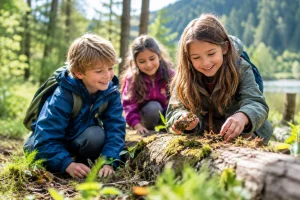
Nature-connected learning adds another dimension. Watching a seed change, searching for minibeasts, noticing cloud shapes or caring for a plant helps children develop wonder and responsibility. These are not extras to “proper” learning. They give young children memorable, sensory-rich experiences from which knowledge can grow.
At Alpine Preschool, purpose-built learning spaces and green outdoor areas give children room to explore these milestones through meaningful play, guided by trained teachers who know when to join in, step back or offer the next gentle challenge.
How parents can support progress at home
The most helpful support is often simple and unhurried. Talk about ordinary moments while preparing meals, travelling or getting ready for bed. Let your child help with manageable tasks, such as pairing socks or watering a plant, even if it takes longer. Read favourite books repeatedly and pause to let them fill in a familiar word or tell you what they notice in the pictures.
Try to protect regular time for open-ended play. A few blocks, animals, fabric pieces, crayons or items collected on a walk can invite more creativity than a toy with only one correct use. Outdoors, children can practise balance, look for patterns in leaves or listen for different sounds. The goal is not to produce a perfect activity, but to show that their questions and ideas are welcome.
Praise effort with specific language. Instead of simply saying “good job”, you might say, “You kept trying different pieces until the puzzle fitted,” or “You were kind when you offered Mia a turn.” This helps children connect success with persistence, thoughtfulness and problem-solving.
When to seek guidance
Every child has their own developmental rhythm, and a quieter period or temporary setback is not automatically a concern. However, it is sensible to speak with your child’s teacher or a suitable health professional if you notice persistent difficulties with communication, interaction, movement, hearing, understanding simple instructions or managing daily routines.
A collaborative conversation is usually the best first step. Teachers can share observations from the nursery setting, while parents provide the fuller picture from home. Together, adults can identify practical strategies and, where needed, seek additional advice early. Support is most effective when it is compassionate, specific and centred on the child’s strengths.
The nursery years should leave children with more than a collection of skills. They should carry forward the feeling that they are capable, valued and curious about what comes next. When children are given time to explore, caring guidance and the freedom to be wonderfully themselves, learning becomes part of a happy childhood rather than a race.