
A child crouching to watch an ant carry a crumb is not simply taking a break from learning. They are noticing patterns, asking questions, practising patience and building a relationship with the living world. The best outdoor classroom features make room for these small but powerful moments, while giving children the security, guidance and structure they need to flourish.
For children aged two to seven, an outdoor classroom should feel full of possibility without becoming overwhelming. It is not just a playground with a few extra plants. It is a thoughtfully planned learning environment where movement, imagination, early literacy, problem-solving and social confidence can grow naturally.
What makes an outdoor classroom meaningful?
A beautiful garden alone does not create meaningful learning. The difference lies in how each space invites children to act, investigate and return to an idea over time. A muddy patch may become a mini construction site one day, a habitat for worms the next and the setting for a story the week after.
The most effective outdoor environments balance freedom with clear boundaries. Children need opportunities to choose, climb, carry, make noise and explore. They also need attentive educators, age-appropriate equipment, predictable routines and spaces that help them feel calm when they need a quieter moment.
10 best outdoor classroom features for preschool children
1. Natural spaces with real things to investigate
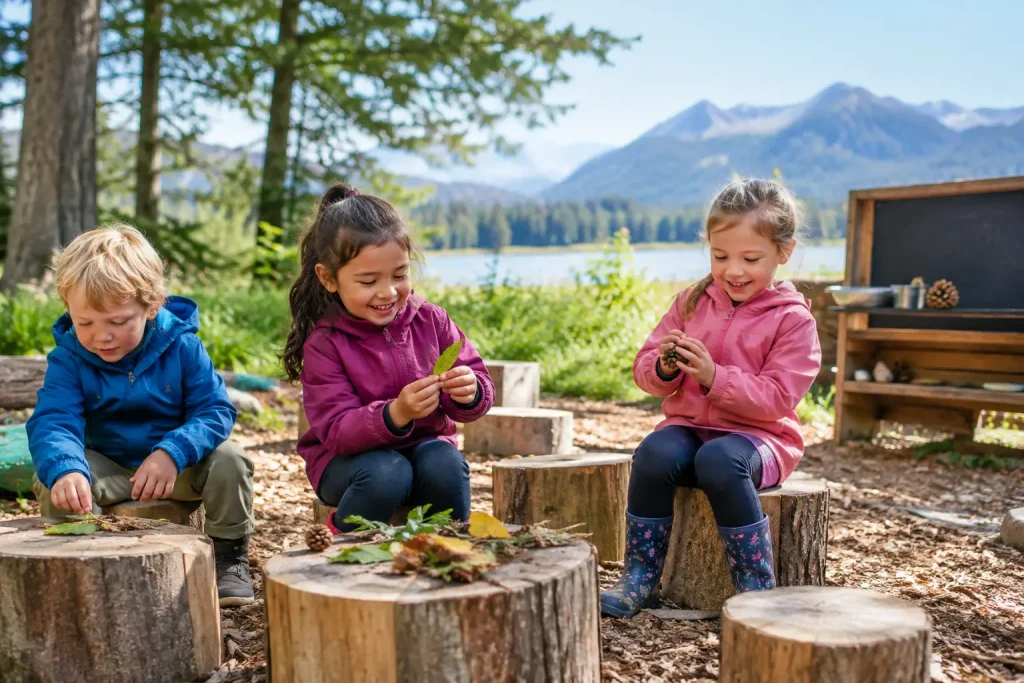
Plants, trees, stones, soil, seed pods and fallen leaves offer more than visual beauty. They provide endless material for sorting, counting, comparing, collecting and imaginative play. As the seasons and weather change, children see that nature is never exactly the same twice.
A varied landscape is more valuable than a perfectly manicured one. Small slopes, planting beds and textured pathways encourage children to use their whole bodies and senses. Of course, surfaces and plants must be selected carefully, with regular checks for safety and suitability.
2. Safe climbing and balancing challenges
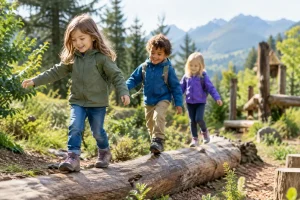
Young children learn confidence by testing what their bodies can do. Low climbing structures, balance beams, stepping logs and gentle mounds help develop coordination, core strength and spatial awareness. They also teach children to assess a challenge: Can I reach that? Where should my foot go next? Do I need help?
The aim is not to remove every manageable risk. It is to create well-supervised, age-appropriate opportunities for children to take sensible risks and experience the pride of progressing. A feature that suits a confident six-year-old may not be right for a two-year-old, so flexible zones matter.
3. A dedicated sensory play area
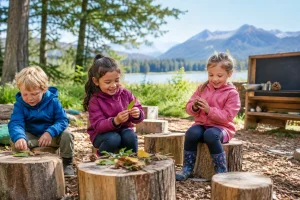
Sand, water, mud and natural loose parts can hold a child’s attention for long periods. Pouring water between containers introduces early ideas about volume and cause and effect. Mixing mud supports creativity and sensory regulation. Scooping, squeezing and moulding strengthen the small muscles needed later for drawing and writing.
Sensory play is especially valuable because there is no single correct outcome. One child may make a river, another may serve a pretend café meal, while a third carefully lines up pebbles by size. Good outdoor classrooms provide easy access to water and materials, alongside clear hygiene routines and careful supervision.
4. Loose parts for open-ended creativity
Crates, bamboo lengths, fabric, tyres, planks, pine cones and large cardboard tubes can become almost anything in a child’s imagination. Unlike fixed equipment, loose parts invite children to plan, negotiate and adapt. A group building a den must decide whose idea to try, how to make it stable and what to do when it falls down.
This kind of play supports independence without forcing children into adult-designed outcomes. The materials should be durable, clean and regularly inspected, but they do not need to be expensive. What matters is variety, safe storage and enough time for children to develop their ideas rather than pack them away too quickly.
5. A calm, shaded reading and reflection corner
Outdoor learning should include lively movement, but it also needs places for rest. A shaded nook with weather-resistant books, cushions, mats or low seating can become a peaceful retreat for stories, drawing and quiet conversations. It gives children a chance to reset after energetic play without having to leave the outdoor environment.
Shade is also a practical priority in warm weather. Trees, canopies and covered verandas help make outdoor learning comfortable across the day. The best solution often combines natural shade with purpose-built cover, so the space remains useful while plants continue to grow.
6. An outdoor art studio
Creative work feels different outside. Children can paint on large vertical surfaces, draw with chalk on paving, weave leaves and grasses, or create temporary patterns from petals and stones. There is room for bigger gestures, messier processes and collaborative projects that would be difficult indoors.
A well-designed art area includes washable surfaces, accessible materials and a nearby place for cleaning up. It should celebrate process rather than perfect results. When children are free to experiment with colour, texture and scale, they build creative confidence alongside fine motor control.
7. A garden children can care for
Growing herbs, vegetables or flowers teaches children that care has a visible result. They can water seedlings, notice new leaves, observe visiting insects and eventually harvest something they have helped nurture. Even if a plant does not thrive, there is a valuable lesson in trying again and learning what it needs.
Gardening also brings meaningful language into daily life: roots, stems, smooth, prickly, damp and fragrant. For preschools, raised beds can make participation easier for younger children and support clear pathways around the growing area. The garden does not need to be large to feel meaningful.
8. Purposeful spaces for imaginative play
A simple outdoor kitchen, market stall, stage or small house can become the backdrop for rich social play. Children take on roles, create rules, practise language and work through everyday experiences. A pretend café may involve writing a menu, counting plates, welcoming a customer and solving a disagreement over who gets to be the chef.
These spaces work best when they are adaptable. A fixed theme can limit imagination, while simple structures and changing props leave room for children to lead. Educators can extend play with thoughtful questions without taking over the story.
9. Weather-ready design for everyday use
Children benefit from experiencing sunshine, light rain, breezes and changing clouds. Yet outdoor learning should not depend on perfect weather. Covered areas, non-slip surfaces, drainage, accessible storage and suitable clothing routines make it possible to spend time outside more consistently.
This is where thoughtful design makes a practical difference for families and educators. If changing shoes or finding waterproofs becomes difficult every day, outdoor learning may become occasional rather than embedded in the programme. A well-organised setting makes nature-connected learning feel like a normal part of childhood.
10. Strong safety systems and trained adult guidance
The finest equipment cannot replace attentive adults. Children need educators who know when to observe quietly, when to ask a question and when to step in. Regular risk assessments, clear sightlines, secure boundaries, first-aid readiness and equipment checks create the foundation that allows children to explore with confidence.
Safety should support exploration, not stop it. At Alpine Preschool, this balance is part of creating a nurturing environment where children can enjoy meaningful outdoor experiences while parents feel reassured by professional care and purposeful planning.
Choosing the right features for your child
When visiting a preschool, look beyond the size of the outdoor area. Notice whether children are actively engaged or waiting for instructions. Are there natural materials within reach? Is there a balance between energetic play and quiet spaces? Do educators speak about outdoor time as part of learning, rather than simply time between lessons?
It also helps to ask how the space changes for different ages. Toddlers need secure opportunities for sensory discovery and early movement, while older preschool children may be ready for more complex building, gardening, collaborative games and problem-solving. A strong setting grows with the child.
The best outdoor classroom is not the one with the most equipment. It is the one where a child feels safe enough to wander, curious enough to ask why, and supported enough to try one more time. That is where ordinary afternoons can become the childhood experiences they carry forward with confidence and joy.