
A child crouching beside a trail of ants is not simply passing time outdoors. They are noticing patterns, asking questions, practising patience and learning that their observations matter. The most meaningful nature based learning examples begin with these small, child-led moments, then give them thoughtful direction through caring adult guidance.
For children aged two to seven, nature is a rich and ever-changing classroom. A puddle becomes an experiment in movement, a fallen leaf invites comparison, and a garden bed creates a reason to care for something beyond oneself. When outdoor experiences are planned with purpose, they support early academic readiness while protecting the wonder that makes childhood so special.
Why nature belongs in early learning
Young children learn through their whole bodies. Before they can describe the difference between rough and smooth, heavy and light, or near and far, they need chances to feel, carry, climb, balance and explore. Natural spaces offer these experiences in a way that feels joyful rather than forced.
Outdoor learning also gives children room to make choices. A child may decide to gather petals, build a shelter from branches or watch a snail closely. Each choice develops independence and concentration. With a trained teacher nearby, these interests can become meaningful learning opportunities that build language, early maths, scientific thinking and social confidence.
Nature-based learning is not about leaving children to entertain themselves outside. Nor does it require every lesson to happen outdoors. The strongest approach combines free exploration with a carefully considered curriculum, so children have time to follow their curiosity and opportunities to extend what they discover.
Nature based learning examples by developmental stage
The same garden, outdoor classroom or green space can support very different learning goals. The activity should meet the child where they are, while offering a gentle next step.
Sensory treasure baskets for toddlers
For younger children in Playgroup or Nursery, a basket filled with safe natural items can create a calm, fascinating sensory experience. Smooth stones, large seed pods, pieces of bark, soft feathers and dry leaves invite little hands to explore texture, weight, shape and sound.
An educator can introduce simple vocabulary such as soft, bumpy, cold and crunchy, repeating words naturally as children play. There is no need to turn the moment into a test. The value lies in allowing children to handle real objects, communicate their reactions and begin making connections through the senses.
Careful selection matters. All materials should be age-appropriate, clean and closely supervised, particularly for children who still explore by putting objects in their mouths. This is one reason a purpose-built preschool environment and attentive teachers make such a difference.
Puddle investigations after rain
A rainy morning can feel like a disruption to a busy family schedule. For a young child, it may be the day’s most memorable lesson. Wearing suitable footwear, children can observe ripples, test which objects float, compare shallow and deep puddles, and notice how water travels along a path.
Teachers can encourage thinking with open questions: “What do you think will happen if we place this leaf in the water?” or “Where do you think the puddle will go when the sun comes out?” These questions support prediction and reasoning without demanding one correct answer.
There are sensible boundaries. Thunderstorms, slippery surfaces and poor drainage call for an indoor alternative. Nature-connected learning should feel adventurous, but it must always be safely managed.
Leaf sorting and pattern making
A collection of leaves offers a beautiful introduction to early maths. Children can sort them by colour, size, edge shape or texture. They might arrange green, yellow, green, yellow to make a repeating pattern, or place leaves from smallest to largest.
This activity is particularly valuable because the materials are imperfect. Two leaves may both appear green but have different veins, spots or shades. Children learn to look carefully, explain their choices and accept that objects can be grouped in more than one way. That flexibility is an important foundation for later problem-solving.
For older kindergarten children, teachers can add simple counting, comparison language and recording. A child might make a tally of the leaves they find or draw the leaf with the most pointed edges.
Growing a small edible garden
Planting herbs, vegetables or flowers gives children a meaningful role in a shared project. They prepare soil, sow seeds, water carefully and wait. The waiting is part of the learning. In a world that often moves quickly, gardening helps children understand that living things need consistent care and time to grow.
As shoots emerge, children can measure growth with blocks or a ruler, draw changes in a garden journal, and talk about what plants need to thrive. Harvesting a small crop can also encourage children to try unfamiliar foods with greater confidence because they helped grow them.
Not every seed will sprout, and that is useful too. A missed watering day or a seed that does not germinate opens a gentle conversation about cause, effect and trying again. Children do not need perfect results to gain something valuable from the process.
Building habitats for small creatures
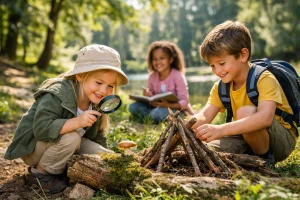
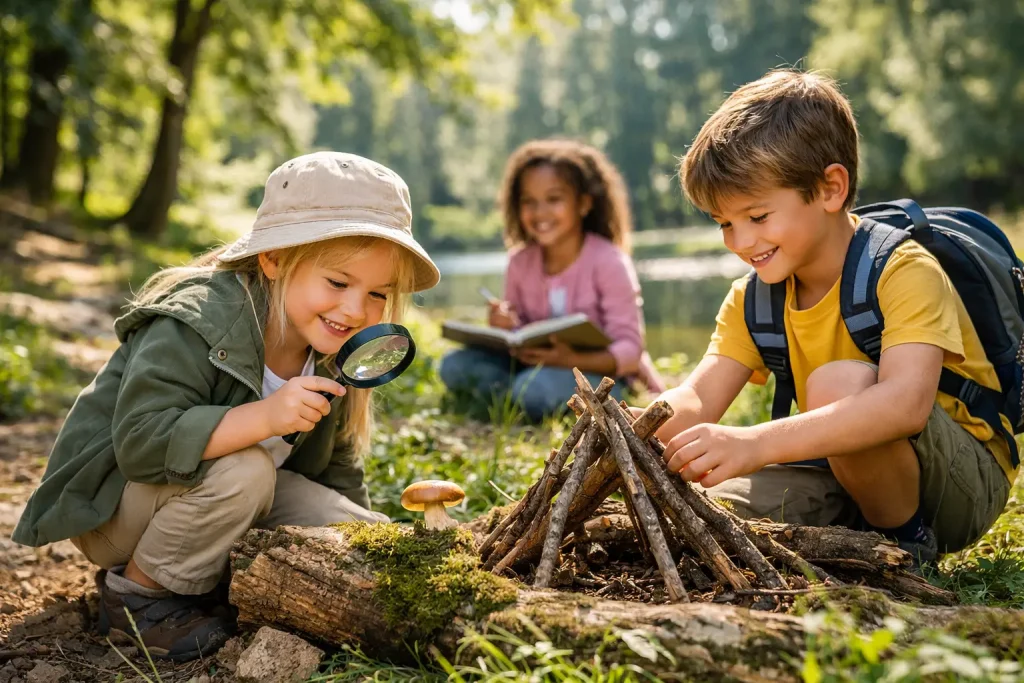
A pile of sticks, leaves, pinecones and stones can become a tiny habitat for insects. As children decide where to place materials, they practise planning, collaboration and spatial awareness. They may negotiate whose idea to try first, adapt a structure that falls down, and feel proud of a shared creation.
The key message is respect. Children can observe minibeasts without poking, trapping or taking them away from where they belong. Teachers can model kindness by reminding children that a creature’s home is important, just as theirs is. This is nature learning with a strong social and emotional purpose.
Outdoor storytelling and imaginative worlds
Nature also nourishes creativity. A shady tree can become a dragon’s cave, a line of stepping stones can become a river crossing, and a collection of twigs can become a fairy village. When children create stories outdoors, they develop vocabulary, narrative sequencing and expressive confidence while moving their bodies freely.
An educator might offer a gentle prompt, such as a lost woodland animal needing a home, then let children shape the story. Some children will speak eagerly; others may prefer to build, draw or act out an idea. A child-centred approach makes room for each form of expression.
What meaningful outdoor learning looks like
Parents sometimes worry that outdoor play means less preparation for school. In reality, well-planned nature experiences can strengthen the capabilities children need for a confident transition to more formal learning. Listening to instructions, taking turns, persisting with a challenge, using descriptive language and recognising patterns all grow through purposeful play.
Quality matters more than simply having access to a playground. Children benefit from inviting green spaces, varied materials, clear routines and educators who know when to step back and when to extend an idea. A teacher who notices a child lining up stones can introduce ordering language. Another who sees children disagreeing over a den can help them practise respectful negotiation.
Weather should be embraced with good judgement. Warm days may call for shade, water and quieter activities; rainy days can offer wonderful discoveries when conditions are safe. There will also be times when an indoor activity is the better choice. The aim is not to prove that every moment must be outside, but to help children build a genuine relationship with the natural world.
Bringing these experiences into everyday childhood
Families do not need a large garden or specialist equipment to make nature part of daily life. A walk can include noticing birdsong, counting steps between trees or collecting fallen leaves for a collage. A balcony pot can become a child’s first responsibility. Even looking closely at clouds before school invites observation and conversation.
At Alpine Preschool, these everyday wonders are given space to grow through outdoor classrooms, green areas and guided experiences that connect play with purposeful development. Children are encouraged to get their hands a little muddy, ask another question and discover what they are capable of doing.
The best nature learning often ends with a child carrying home a leaf, a story or a question they cannot wait to share. That sense of curiosity is worth making room for, because it can keep growing long after the day’s play has finished.