
A child offering a bucket to a new friend, waiting while someone else takes a turn, or finding the words to say, “Can I join?” may look like small moments. They are not. These everyday exchanges are where friendships, confidence and empathy begin. The best preschool activities for social skills create these moments naturally, giving children warm guidance and plenty of chances to practise together.
Social development is not about expecting young children to share perfectly or agree all the time. It is about helping them notice others, express their needs, recover from disappointment and feel that they belong in a group. For children aged two to seven, purposeful play is one of the most meaningful ways to learn these lifelong skills.
Why social skills need time, not pressure
Young children are still learning to manage big feelings, understand another person’s point of view and use language when something feels unfair. A child who grabs a toy is not necessarily being unkind. They may be excited, overwhelmed, unsure how to join in, or simply not yet able to wait.
This is why social learning works best in a calm, well-prepared environment. Trained educators can put words to what children are experiencing: “You both want the red spade. Let’s find a way for each of you to have a turn.” Over time, children borrow this language and begin to use it independently.
The activities below work because they are enjoyable first. They offer a real reason to communicate, cooperate, negotiate and care for others, rather than turning friendship into a lesson to memorise.
Best preschool activities for social skills through play
1. Partner building challenges
Give two or three children blocks, natural loose parts or recycled materials and a simple shared invitation: build a bridge for the toy animals or create a home that can shelter them from the rain. The goal is not a perfect structure. It is the conversation that happens as children decide where each piece belongs.
Adults can support without taking over by asking, “What is your friend’s idea?” or “How can you make room for both plans?” Partner construction encourages listening, turn-taking and flexible thinking. For younger children, use fewer materials and shorter challenges; older children may enjoy planning, testing and rebuilding together.
2. Cooperative obstacle courses
Outdoor movement play gives social learning an energising, joyful setting. Create an obstacle course where children carry a ball together on a tray, guide a partner through a pathway, or help each other balance across stepping stones.
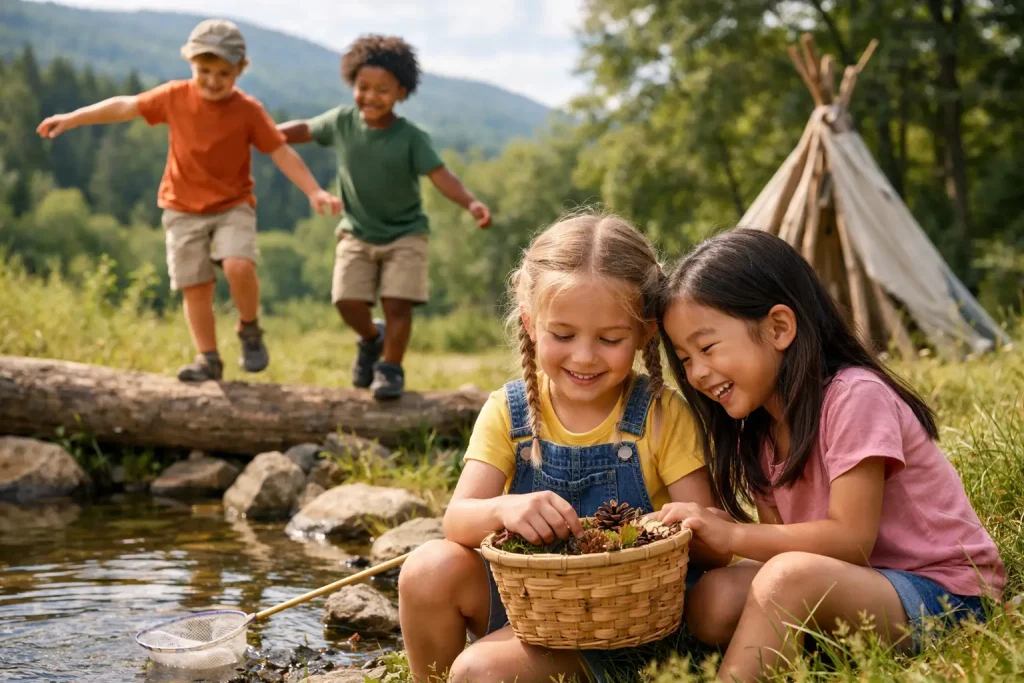
Some children flourish in active play because talking face-to-face can feel demanding. Working side by side can make connection easier. Nature-connected spaces are especially valuable here: uneven ground, logs, sand and open grass invite children to assess risk, offer a hand and celebrate each other’s efforts.
3. Pretend-play corners with a shared purpose
A well-stocked home corner, clinic, café, market or travel station can become a small social world. Children choose roles, make rules and respond to each other’s ideas. One child might be the customer, another the chef, while a third delivers food or cares for a doll.
Pretend play supports language, empathy and cooperation because children are practising different perspectives. It also reveals what they may need help with. If one child repeatedly controls every role, an educator can gently widen the play: “This café needs someone to welcome guests. Who would like to do that?”
4. Circle-time greeting games
A predictable greeting routine helps every child feel seen. Passing a soft object around the circle, saying each child’s name, or choosing a friendly movement for the group to copy are simple ways to build belonging.
Keep these games short, especially for younger preschoolers. Children should never be forced to speak or perform before they are ready. A wave, a smile, holding up a picture card or joining in from an adult’s lap can be a meaningful first step towards group confidence.
5. Storytelling with feelings
Choose stories with relatable social moments: a character who feels left out, two friends who want the same thing, or someone who makes a mistake and repairs it. Pause at key points and ask what the character might be feeling, then invite children to suggest a kind next step.
The value is not finding one correct answer. Children learn that feelings can look different from person to person, and that problems can be worked through. Puppets are particularly helpful for children who find it easier to speak through a character than about themselves.
6. Small-group art projects
Individual painting is valuable, but a shared mural, collage or garden sign brings a different kind of learning. Children must make space, pass materials and decide how separate contributions can belong together.
Offer inviting materials in enough quantity to reduce unnecessary conflict, while retaining a few choices that require discussion. An educator might say, “There is one large piece of blue paper. What could we do?” The children may choose to take turns, use it together or find another solution. Each is a useful social outcome.
7. Gardening and caring for living things
Planting seeds, watering herbs and observing insects offer gentle opportunities for collaboration. A group can decide who fills the watering can, who checks the seedlings and who records what has changed. The shared responsibility gives children a reason to depend on one another.
Gardening also nurtures kindness in a broader sense. When children learn to care for a plant, a worm or a butterfly garden, they begin to see that their actions affect the world around them. This is one reason outdoor classrooms can be such a magical place for early childhood learning.
8. Musical turn-taking games
Music naturally gathers children together. Try passing instruments around a circle, copying a partner’s rhythm, or creating a soundscape in small groups for a familiar story. These activities strengthen attention and self-control without feeling formal.
A child who finds waiting difficult may manage it more successfully when their turn is signalled by a favourite drumbeat or song. Keep the pace lively and celebrate quiet listening as much as enthusiastic participation.
9. Team scavenger hunts
Rather than asking children to race against one another, set a shared outdoor mission: find three smooth leaves, something that smells interesting and a place where ants might travel. Pair children so they need to look, wonder and decide together.
This is particularly effective for children who are new to a group. A shared task removes the pressure to make conversation from nothing. By the time they return with their discoveries, they have already created a small shared experience.
10. Friendship problem-solving role play
When common conflicts arise, revisit them later through puppets or simple role play. A puppet may want the same tricycle as another puppet, or may be unsure how to enter a game. Ask children for words that could help: “Can I have a turn when you are finished?” or “Can we play together?”
It is better to practise these phrases when everyone is calm than to demand them in the middle of tears. However, scripts should not become rigid. Children need permission to say no, to choose another activity and to seek adult help when a situation does not feel safe or fair.
11. Collaborative cooking and snack preparation
Making fruit kebabs, mixing dough or arranging a simple shared snack offers many natural roles. Children can wash, stir, count, serve and tidy together. They also experience the pleasure of contributing to something the whole group can enjoy.
Food activities need careful supervision and attention to dietary needs, but they can be wonderfully inclusive when planned thoughtfully. A child who is hesitant in large-group conversation may feel proud being the person who offers a napkin or helps a friend find a seat.
12. Kindness noticing at the end of the day
A brief reflection can help children recognise the social successes that might otherwise pass unnoticed. Instead of broad praise such as “Good job”, be specific: “I noticed you waited for Aisha to finish speaking,” or “You helped put the baskets away when your friend was tired.”
Children do not need rewards for every kind act. The aim is to help them connect actions with feelings and outcomes. When kindness is noticed consistently, it becomes part of the group’s shared culture.
The educator’s role makes the difference
No activity guarantees instant friendship. The same gardening project may lead one group into easy cooperation and another into disagreement. Both experiences can be valuable when an attentive adult helps children slow down, name the problem and try again.
At Alpine Preschool, social growth is woven into play-based learning, outdoor exploration and daily routines rather than treated as an extra subject. Purposeful spaces, clear boundaries and warm teacher relationships give children the security to take social risks: to ask, apologise, lead, listen and begin again.
Bringing social learning into everyday life
Parents can extend these experiences at home without creating a timetable of lessons. Invite your child to help prepare for a visitor, choose a book for a sibling, or tell you how they think someone felt in a story. When conflict happens, acknowledge the feeling before guiding the behaviour: “You are cross because you wanted that first. It is alright to feel cross. Let’s find words that help.”
The most lasting social skills grow in ordinary, repeated moments of connection. Give children time to play alongside others, patient language for difficult feelings and the reassurance that they can make a mistake without losing their place in the group. That is how a child gradually learns not only how to make friends, but how to be one.