A child carefully pouring water between two small jugs may look as though they are simply playing. Yet in that quiet moment, they are building hand control, concentration, language, confidence and the ability to try again when the water spills. The most meaningful early years learning examples often look wonderfully ordinary because young children learn best through experiences that engage their whole selves.
For parents, this can be reassuring. High-quality early education is not a race towards worksheets or memorising facts. It is a carefully guided journey in which play, relationships, movement, conversation and discovery help children make sense of the world. A thoughtful preschool environment gives these everyday moments purpose, while leaving room for childhood wonder.
What meaningful learning looks like in the early years
Between the ages of two and seven, children are developing at an extraordinary pace. They are learning how to communicate their needs, manage feelings, build friendships, notice patterns, use their bodies with increasing control and ask deeper questions. These skills support later reading, writing and mathematics, but they also shape how confidently a child approaches new situations.
The strongest learning experiences have a clear intention behind them. A trained teacher may set out natural materials for sorting, plan a story session around a child’s interest in insects, or turn a disagreement over a toy into a chance to practise kind language. The activity is enjoyable, but the adult observes, listens and knows what development it can support.
Learning should also feel achievable. A task that is too easy offers little growth; one that is too difficult can leave a young child discouraged. The right level of challenge changes from child to child, which is why attentive teaching and small, responsive interactions matter so much.
Early years learning examples at home and school
Children do not divide their development into subjects. For them, a walk outside, a conversation at lunch and a building project can all become rich learning opportunities. These examples show how purposeful experiences can grow several abilities at once.
Nature walks that lead to real questions
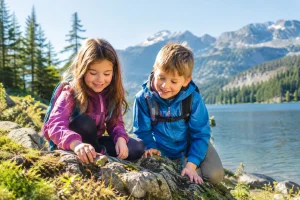
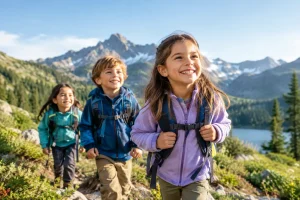
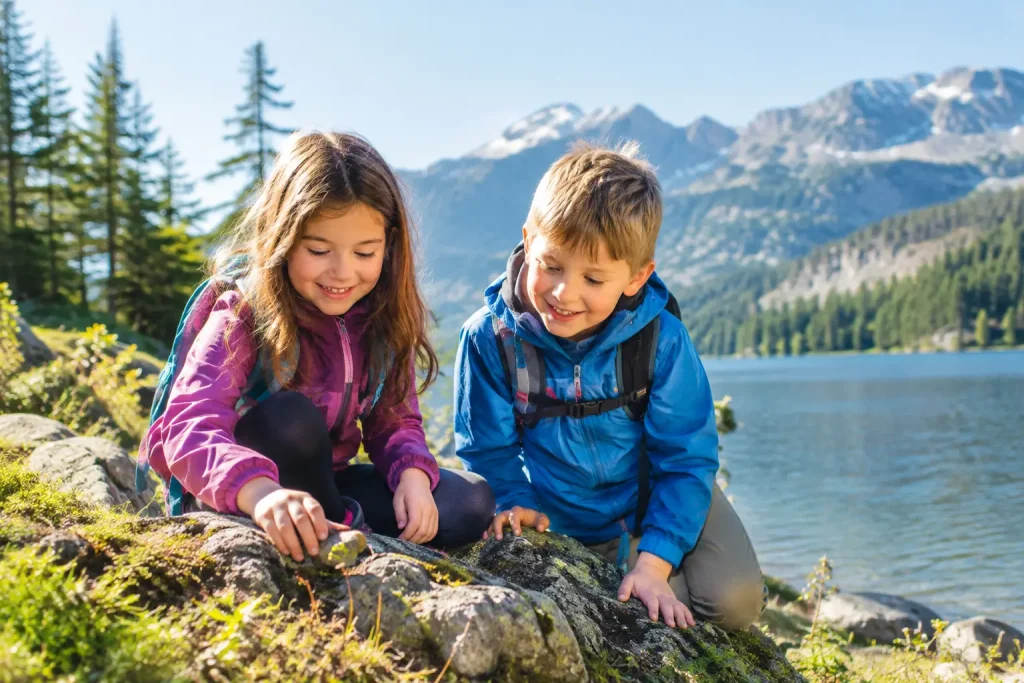
A nature walk is far more than time outdoors. A child might collect leaves, compare their shapes, spot an ant carrying food or notice that a puddle has disappeared after the sun comes out. With gentle prompts such as, “What do you think happened here?” or “How could we find out?”, an adult encourages observation and early scientific thinking.
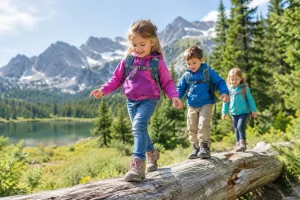
Outdoor learning also gives children space to move, take managed risks and reset emotionally. Climbing a low structure, balancing on a log or navigating uneven ground develops coordination and body awareness. For some children, outdoor exploration is where they speak most freely and show their clearest ideas.
At a nature-connected preschool, outdoor classrooms can make this exploration part of the rhythm of the day rather than an occasional treat. The aim is not to make every walk into a lesson. It is to give children time, safety and thoughtful guidance to notice what interests them.
Water, sand and sensory play
Scooping sand, squeezing wet sponges and mixing mud are deeply satisfying for young children. They are also valuable ways to develop sensory awareness, fine motor strength and early mathematical language. Children begin to understand concepts such as full and empty, heavy and light, more and less, floating and sinking through direct experience.
Sensory play can be especially helpful for children who need time to settle into a new environment or find words for what they feel. A calm water tray may invite cooperative play without the pressure of a formal group task. The teacher’s role is to add language naturally: “Your channel is getting wider,” or “What might happen if we add another cup?”
There is a balance to strike. Sensory activities need clear boundaries, safe materials and time for children to tidy up together. Learning to care for a shared space is part of the experience too.
Storytelling that builds language and empathy
Reading aloud remains one of the simplest and most powerful early learning experiences. When adults pause to wonder about a character’s feelings, predict what may happen next or invite a child to retell a favourite scene, stories become conversations rather than performances.
A child who says, “He is sad because nobody asked him to play,” is building vocabulary and emotional understanding at the same time. Acting out a familiar tale with puppets, costumes or blocks can help children who are not yet ready to explain their ideas in a full sentence. It also gives them a safe way to explore bravery, fairness, worry and friendship.
Choose books that reflect different families, cultures and experiences. Seeing their own world represented helps children feel that they belong, while meeting other perspectives builds respect and curiosity.
Building, sorting and problem-solving
Blocks, loose parts, puzzles and recycled materials invite children to think like designers. A child building a bridge for toy animals must decide which pieces will hold, what to do when the structure falls and whether a different approach might work better. That is early engineering, persistence and flexible thinking in action.
Sorting shells by size, arranging buttons by colour or matching socks during a practical routine introduces classification and pattern. These are foundations for mathematical understanding, but there is no need to rush towards correct answers. Asking, “How did you decide?” often reveals more than asking, “What is the answer?”
Adults can support without taking over. If a tower repeatedly topples, it may be tempting to fix it straight away. Instead, try: “It looks wobbly. What could make the bottom stronger?” The child keeps ownership of the solution and learns that mistakes are useful information.
Everyday independence and self-care
Putting on shoes, serving a snack, washing hands thoroughly and packing away resources may seem small beside a planned creative activity. In fact, these routines are central to early development. They strengthen coordination, sequencing, responsibility and self-belief.
A child who learns to fasten a coat after several attempts experiences a genuine sense of achievement. Adults can make this possible by allowing enough time, offering one clear step at a time and noticing effort rather than only speed. “You kept trying until the zip reached the top” is more meaningful than a quick “Well done”.
Independence does not mean expecting children to manage everything alone. It means giving support that gradually reduces as competence grows. Some children will happily pour their own drink at two; others may need more practice and encouragement. Development is not a competition.
Creative expression without a fixed outcome
Art is most valuable when children can make choices. Rather than showing every child a finished model to copy, offer a small range of materials and a starting invitation: create a home for a woodland creature, make marks to show rain, or use clay to build something that can hold a tiny treasure.
This approach develops imagination, planning and confidence in original ideas. It also allows teachers to learn about the child. One child may spend twenty minutes carefully mixing colours, while another creates a fast-moving story with paint. Both are communicating.
The finished artwork matters less than the thinking behind it. Displaying children’s words alongside their creations shows that their ideas are valued, not just their ability to produce something neat.
The adult makes the difference
Resources alone do not create meaningful learning. The quality of the relationship around the experience is what helps it become memorable and developmental. Children need adults who are warm, observant and consistent, while also knowing when to step back.
A skilled educator notices the child who watches from the edge of a group and offers a gentle way in. They recognise when a repeated game is helping a child master an idea, rather than dismissing it as boredom. They extend learning with a carefully chosen question, fresh material or shared word, without turning every moment into instruction.
At Alpine Preschool, this child-centred approach is supported by structured stages that respect changing developmental needs. From early readiness and social confidence to growing cognitive skills and school preparation, children need both freedom to explore and a reassuring framework around them.
How parents can recognise a rich learning environment
When visiting a preschool, look beyond whether the room appears busy or whether children are producing matching crafts. Notice the quality of interaction. Are teachers speaking to children with respect? Do children have opportunities to choose, move, collaborate and spend time outdoors? Is there a calm routine alongside opportunities for active discovery?
It is also worth asking how the setting shares children’s progress. Meaningful assessment in the early years is built from observations, conversations and an understanding of development. It should help teachers plan next steps, not turn childhood into a checklist.
The best early years learning examples are rarely the loudest or most polished. They are the moments when a child wonders, tries, connects and realises, perhaps for the first time, “I can do this.” Giving children many such moments is one of the most generous foundations we can offer.