
A puddle after morning rain can become a child’s first science lesson, a shared challenge and a reason to use new language. This outdoor learning case study follows a representative preschool morning to show what children gain when time outside is planned with the same care as time indoors.
For parents, outdoor learning can sometimes sound like free play with a nicer view. Free play matters deeply, but meaningful nature-connected education is more intentional than simply taking toys into the garden. It combines child-led discovery with skilled teaching, clear routines and experiences matched to each stage of development.
Outdoor Learning Case Study: A Morning of Discovery
Imagine a group of four- and five-year-olds arriving at an outdoor classroom after a wet night. Their teacher has noticed that the ground is damp, small pools of water have formed and leaves have gathered along the pathway. Rather than moving the morning indoors, she uses these changing conditions as the starting point for learning.
The children begin with a familiar welcome routine. They put on suitable footwear, talk through boundaries and check which areas are ready to explore. This predictable start helps children feel secure. Safety is not separate from independence here – it gives children the confidence to make choices within clear, age-appropriate limits.
One child notices that a leaf is floating while a twig sinks. Another begins filling a container with water, then watches it overflow. The teacher does not rush to provide the answer. She asks, “What do you think will happen if we add more?” and “How could we find out?” These small questions invite observation, prediction and persistence.
At first, the children may simply enjoy splashing. That enjoyment is valuable. As the experience continues, however, the teacher can gently extend it through vocabulary such as float, sink, shallow, full and empty. Children compare sizes, take turns with containers and explain their ideas to friends. A spontaneous puddle investigation now supports early science, mathematical thinking, communication and social development at once.
What Skilled Teachers Notice Outside
The most meaningful learning is often easy to miss if adults only look for a finished product. In an outdoor setting, trained teachers observe how a child approaches a challenge, responds to others and uses their body as carefully as they observe what the child makes.
During the puddle activity, one child may be confidently measuring water but find it difficult to wait. Another may stand back quietly before offering a thoughtful observation. A third may hesitate to touch mud, then decide to try with encouragement from a friend. Each response tells the teacher something useful about confidence, sensory preferences, communication and readiness for the next step.
This informs what comes next. A child who is ready for more complexity might be invited to compare which container holds the most water. A child developing language might be encouraged to describe the texture of wet soil. A child who needs reassurance can begin with a small, manageable role, such as carrying leaves to a collection tray.
This is one reason outdoor learning should not be treated as an occasional reward after “real” work. It is a rich environment for real assessment and responsive teaching. Children often reveal strengths outdoors that are less visible during a table-based activity.
Confidence grows through manageable risk
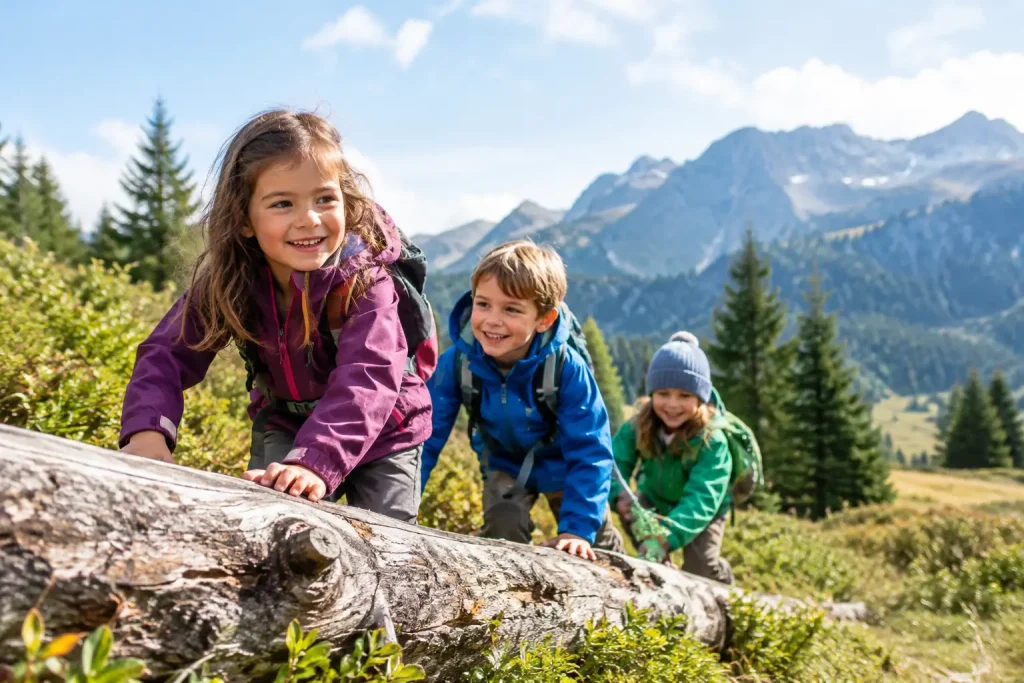
A low log, a slope or a stepping-stone path can look simple to an adult. For a young child, it asks for balance, judgement and courage. With a teacher nearby, children learn to assess their own movements: where to place a foot, when to slow down and when to ask for help.
The goal is not to remove every challenge. It is to make challenge thoughtful. A well-designed outdoor environment is checked, supervised and organised so children can take suitable risks without being placed in unsafe situations. This balance helps them develop body awareness and self-belief – qualities that support learning far beyond the playground.
Relationships become part of the learning
Outdoor spaces naturally create reasons to collaborate. Building a shelter from loose materials, carrying a large branch together or agreeing on rules for a pretend café requires children to listen, negotiate and contribute.
These moments do not always run smoothly. Disagreements over a favourite bucket or a carefully built den are normal. They are also valuable opportunities for teachers to model kind language, support problem-solving and help children recognise another person’s point of view. For young children, social confidence is built through these repeated, everyday interactions.
From Open-Ended Play to Early Academic Foundations
Parents rightly want to know how play-based learning prepares children for later academic life. The answer is not that every outdoor activity must become a formal lesson. Rather, purposeful experiences give early concepts a meaning children can feel, see and remember.
When children sort pinecones by size, they are meeting comparison and classification. When they count steps to the garden gate, they are connecting number to movement. When they draw the patterns they find on a leaf, they strengthen the hand control and observation needed for early writing. A story told beneath a shady tree can build attention, imagination and listening skills in a way that feels memorable rather than pressured.
There is a trade-off to consider. Outdoor learning alone is not a complete curriculum, just as worksheets alone cannot meet every developmental need. Young children benefit from a considered rhythm that includes outdoor exploration, creative work, stories, conversation, purposeful indoor learning and quiet moments to reset. The strength lies in connecting these experiences rather than placing them in competition.
At Alpine Preschool, this connection is supported through a structured curriculum that respects each child’s developmental stage. Outdoor classrooms and green spaces are not an add-on to the school day. They offer another meaningful setting in which children can practise the skills introduced through their wider learning journey.
Why Repetition Matters More Than One Big Adventure
An excursion to a forest or farm can be magical, and special experiences have a valuable place in childhood. Yet the greatest developmental benefits often come from regular access to familiar outdoor spaces.
When children return to the same garden week after week, they notice change. A bare patch becomes a place where new shoots appear. The route that once felt difficult becomes easy to navigate. A child who watched others use the climbing structure may gradually decide they are ready to try.
Familiarity also makes deeper inquiry possible. Instead of being overwhelmed by a new environment, children can build on what they already know. They begin to care for their space, remember its rhythms and see themselves as capable participants within it.
For children aged two to seven, the level of challenge should change with them. Younger children may explore sound, texture, movement and simple cause and effect. Older children can take on longer projects, make plans, record findings and work together towards a shared goal. The setting may remain the same, but the learning becomes richer as children grow.
What Parents Can Look For in Quality Outdoor Learning
Not every activity labelled “outdoor learning” offers the same value. A high-quality programme has more behind it than fresh air and a timetable slot. Parents should look for an environment where outdoor areas are well maintained, routines are clear and teachers know how to extend children’s ideas without taking over.
It is also worth asking how learning is documented and communicated. Photographs can be lovely, but a meaningful update explains the learning beneath the picture: the problem a child solved, the language they used, the skill they practised or the confidence they showed. This helps families see progress in a fuller way.
Practical details matter too. Children need appropriate clothing, thoughtful supervision, access to shade and water, and plans that adapt to weather conditions. A quality setting does not view rain, heat or a change of plan as a failure. It responds sensibly, protecting children’s wellbeing while preserving opportunities for discovery.
The strongest outdoor learning experiences give children something increasingly rare: time to wonder before an adult supplies the answer. When a child is trusted to notice, try, rethink and try again, they begin to see learning as an adventure they can take part in. That feeling of capable curiosity is a wonderful foundation for the years ahead.