



A toppled block tower, a turn on the swing that ends too soon, a shoe that will not go on – for a toddler, small frustrations can feel enormous. Learning how to nurture toddler resilience is not about asking children to be tough or expecting them to stop crying. It is about giving them the security, language and repeated experiences they need to meet life’s little disappointments with growing confidence.
Resilience in the early years begins with connection. When a child knows that a caring adult will notice their feelings and stay close while they work through a challenge, they slowly learn a powerful message: difficult moments can be managed. This foundation supports not only emotional wellbeing, but also curiosity, independence and a lasting willingness to try.
What resilience looks like in toddlers
A resilient toddler is not always cheerful, calm or cooperative. Toddlers are still developing the ability to regulate big feelings, and tears, protests and sudden changes of mind are a natural part of this stage. Resilience is visible in the recovery that follows: a child accepts comfort after a fall, returns to a puzzle after becoming cross, or tries again after spilling water.
It also looks different from one child to another. A naturally adventurous child may need support to pause and consider safety, while a more cautious child may need gentle encouragement to join an unfamiliar activity. The aim is not to make every child behave in the same way. It is to help each one feel capable of facing manageable challenge.
Begin with a safe, predictable base
Toddlers are more able to take small emotional risks when the shape of their day feels familiar. Predictable routines for arriving, eating, resting, playing and leaving give children a sense of control before they have the words to understand time fully. A simple warning such as, “In five minutes, we will tidy up and wash hands for lunch,” can make a transition feel far less alarming.
This does not mean every day needs to be rigid. Life includes unexpected rain, a different teacher or a change of plans. Rather than avoiding these moments, name them calmly. “We cannot go to the park today because of the storm. I know that is disappointing. Let’s choose an indoor game together.” Your steady manner shows that a plan can change without everything falling apart.
Warm reconnection matters too. A few unhurried minutes after nursery or preschool, without immediately asking lots of questions, can help a child settle. Offer a snack, sit nearby or invite them to show you something they made. Children often share more once they feel they are not being tested.
Name feelings before trying to fix them
When a toddler is overwhelmed, logic alone rarely helps. “There is no reason to cry” may be well meant, but it can leave a child feeling unseen. Start by describing what you notice: “You are very upset because the red cup is in the dishwasher,” or “You wanted to keep playing.” This does not give in to every request. It lets the child know their experience makes sense.
Then hold the boundary with kindness. “You may be cross. The cup still needs washing.” Over time, this combination of empathy and clear limits helps children understand that feelings are welcome, while some actions are not. Hitting, throwing toys at people or biting still need a calm stop: “I will not let you hit. You are angry. I am here to help you be safe.”
Toddlers borrow an adult’s calm before they can create much of their own. If you can soften your voice, get down to their level and use fewer words, you make it easier for their nervous system to settle. Of course, adults have difficult days too. Repairing after a tense moment is valuable: “I spoke loudly. I was frustrated, but I should have spoken more gently. I am sorry.” This teaches that relationships can recover.
Offer challenges that are small enough to succeed
Confidence grows from doing, not from constant praise. Give your child a chance to attempt everyday tasks before stepping in: pulling up a zip, carrying a light bag, pouring water from a small jug or choosing between two weather-appropriate outfits. These moments may take longer, and there will be spills. That is part of the learning.
The right level of challenge matters. If a task is far beyond a child’s current ability, repeated failure can lead to avoidance. If adults always complete it for them, there is little chance to practise. A helpful middle ground is shared effort: “You start the zip, and I will hold the bottom,” or “Let’s put away five blocks together.” As skills grow, quietly reduce your help.
Try to praise effort with specific, honest language rather than broad labels. “You kept trying different pieces until the puzzle fitted” tells a child what they did well. “You were disappointed, then you took a breath and asked for help” makes coping strategies visible. The message is not that they must succeed first time. It is that persistence, help-seeking and trying another way all count.
Let play and nature do their quiet work
Play offers toddlers a safe rehearsal space for uncertainty. A pretend café, a muddy kitchen or a den made from cushions gives children chances to make choices, negotiate, imagine problems and solve them. Adults do not need to direct every moment. Often, attentive observation and a timely question are enough: “Your bridge keeps falling. What could make it stronger?”
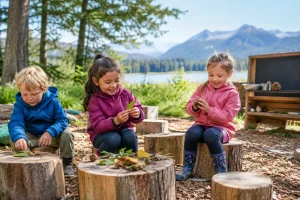
Outdoor play adds a particularly rich kind of challenge. Uneven ground, climbing frames, puddles, loose natural materials and changing weather invite children to assess their bodies and adapt. A child who balances along a low log, slips, then decides to hold an adult’s hand before trying again is building both physical confidence and emotional resilience.
Reasonable risk is not the same as unnecessary danger. Supervision, well-maintained spaces and age-appropriate equipment are essential. Within those boundaries, allowing children to test themselves is often more helpful than repeatedly saying, “Be careful.” Try a more useful prompt: “Look where your feet are,” “Would you like my hand?” or “What is your plan for getting down?”
At Alpine Preschool, nature-connected experiences and outdoor classrooms give children meaningful opportunities to explore, cooperate and discover what they can do. These everyday adventures are not simply energetic play. They help children develop judgement, perseverance and delight in learning.
Teach problem-solving in everyday language
Toddlers do not need lengthy lessons in resilience. They need simple words they can use in the moment. When conflict arises over a toy, guide rather than immediately solve: “You both want the digger. What can we do?” You may offer choices if needed: wait for a turn, find another vehicle, or use a timer with adult support.
The goal is not to expect toddlers to negotiate perfectly. It is to show them that problems have more than one possible response. The same approach works after a knock to a tower or a broken biscuit. “Oh dear, that did not go as you hoped. Shall we see what might help?”
Stories can also give children language for brave feelings. While reading together, pause to wonder about a character: “She looks worried about joining the game. What could she say?” Keep it light and imaginative. Children often understand their own experiences more easily when they first explore them through a story.
Make room for rest, joy and belonging
Resilience is not built through challenge alone. A tired, hungry or overstimulated toddler has fewer resources for coping. Regular sleep, nourishing meals, calm transitions and periods of unstructured play all support emotional balance. Some children need lively movement after a busy morning; others need quiet time with books, drawing or a familiar comfort toy.
Belonging is equally protective. When children are greeted by name, included in simple family responsibilities and valued for who they are, they become more willing to engage with the world. Cultural traditions, home languages, favourite songs and family stories can all strengthen that sense of being known.
Avoid treating every struggle as a lesson that must be solved quickly. Sometimes the most supportive response is to sit beside your child while they cry, then offer a cuddle and carry on with the day. Their resilience grows in those ordinary moments of being loved through disappointment.
The next time your toddler says, “I can’t,” try adding one gentle word: “You can’t do it yet.” Stay close, allow time, and notice the smallest step forward. That is where resilient hearts begin to grow.