



The morning rush can make it tempting to zip the coat, carry the bag and answer every question for your child. Yet the small pause while they try the zip themselves, choose between two fruit options or carry their own water bottle is where confidence begins. Learning how to develop preschooler independence is not about expecting a young child to manage alone. It is about offering safe, patient opportunities to say, “I can try.”
For children aged two to seven, independence grows through warm relationships, predictable routines and meaningful responsibility. It supports practical skills, certainly, but it also helps children develop perseverance, decision-making and a secure sense of self. These are foundations for happy learning at home and in preschool.
How to develop preschooler independence through everyday routines
Preschoolers learn best when a task is familiar, manageable and repeated often enough to become their own. Rather than adding a long list of jobs to the day, look at the routines already happening in your home. Dressing, mealtimes, tidying up, washing hands and preparing to leave all contain valuable moments for participation.
Start by slowing one routine down. A child who is learning to get dressed may first pull on their socks while an adult manages the more fiddly fastenings. Later, they can practise putting shoes on the correct feet, then opening and closing a simple zip. The aim is not a perfectly dressed child every morning. The aim is for them to experience genuine progress.
Clear organisation makes this far easier. Keep everyday clothes in a low drawer or basket, place a sturdy step stool by the sink, and give toys a consistent home marked with a simple picture where useful. When children can reach what they need and understand where it belongs, they are more likely to act independently rather than wait to be directed.
Language matters too. Try saying, “Would you like to try first, or shall we do it together?” This keeps support available without taking over. Praise the effort in a specific way: “You kept trying even when the sleeve turned inside out.” This encourages persistence more effectively than a broad “Good job”.
Give choices, but keep them purposeful
Choice gives preschoolers a healthy sense of agency. Too many choices, however, can feel overwhelming and lead to frustration. A thoughtful choice is limited, clear and acceptable to the adult either way.
At breakfast, offer porridge or toast. Before heading outdoors, ask whether they would like the red jumper or the blue one. During play, invite them to decide if they would rather paint, build or look at a book first. These small decisions communicate that their preferences matter while preserving the boundaries children need to feel secure.
There will be times when choice is not available. Leaving on time, holding hands near a road and brushing teeth are family expectations, not negotiations. You can still acknowledge feelings with warmth: “You wanted to keep playing. It is hard to stop when you are enjoying yourself. It is time to brush teeth now.” Independence is not the same as control. It develops most confidently within calm, consistent limits.
Let children contribute to family life
A preschooler often wants to be useful long before they can complete a task to an adult standard. Welcoming that desire builds belonging as well as capability. Children can place napkins on the table, put laundry into a basket, water plants, match clean socks, feed a pet with supervision or help pack a bag for an outing.
Choose jobs that have a real purpose. A child is more motivated by carrying their own plate to the kitchen than by completing a chore invented simply to keep them busy. Expect spills, mismatched socks and slightly uneven table settings. Those are not signs that the experience has failed. They are signs that learning is happening.
It also helps to break tasks into small steps. Instead of saying, “Tidy your room,” try, “Please put the blocks in this basket, then we will put the books on the shelf together.” As children gain confidence, they can manage more of the sequence independently.
Allow enough time for trying
Independence rarely fits neatly into a hurried schedule. If every morning is a race against the clock, children may hear “I’ll do it” so often that they stop attempting tasks themselves. Where possible, build in a few extra minutes for the skills your child is practising.
This does not mean turning every moment into a lesson. Some days you will need to help with shoes, carry a tired child or finish packing their bag. Responsive care remains essential. The difference lies in recognising these moments as exceptions rather than automatically doing everything for them.
Build independence through play and outdoor exploration
Play offers children a wonderfully natural way to practise independent thinking. Open-ended materials such as blocks, water, clay, loose parts, crayons and imaginative props allow children to plan, test ideas and solve small problems. When an adult immediately shows the “right” way to use every material, some of that discovery is lost.
Try observing before stepping in. If a tower falls, you might say, “You are looking closely at the blocks. What could you try next?” If a child is unsure how to begin a drawing, offer materials and encouragement without deciding what it should become. Your calm presence gives them confidence to explore.
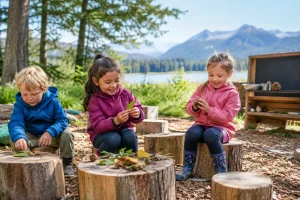
Outdoor play adds another valuable dimension. Uneven ground, climbing structures, sand, gardens and natural objects invite children to assess movement, take manageable risks and adapt their ideas. A child working out how to balance on a low log or carry a small watering can is developing coordination and judgement alongside independence.
Naturally, freedom must match a child’s age, confidence and the environment. Younger children need close supervision, particularly around water, heights, roads and tools. The goal is not risk for its own sake. It is the chance to meet appropriate challenge in a safe setting and discover, “I can work this out.”
At Alpine Preschool, nature-connected experiences and thoughtfully prepared learning spaces give children daily opportunities to make choices, care for materials and explore with growing confidence. This kind of guided freedom helps independence feel joyful rather than pressured.
Support problem-solving without rescuing too quickly
When a child struggles, it can be difficult to watch. A puzzle piece will not fit. A friend says no. A snack container will not open. These moments are also invitations to build resilience, provided the challenge is not too far beyond their current ability.
Pause before offering the answer. You might ask, “What have you tried?” or “Which part feels tricky?” Sometimes a hint is enough: turn the piece around, hold the container steady, or use words such as “Can I have a turn when you are finished?” This approach, often called scaffolding, gives just enough support for a child to continue.
Be careful not to make independence a test. Children need to know that asking for help is a strength, not a failure. A useful message is, “You tried it yourself, and now you need help. We can solve it together.” This protects confidence while teaching children to recognise their limits and seek support appropriately.
Create consistency between home and preschool
Children flourish when the adults around them share similar expectations. Ask your child’s teachers which self-help skills they are practising, whether that is handwashing, putting away materials, opening lunch containers or speaking up during group activities. You can then create simple opportunities to rehearse the same skills at home.
Progress will not always look linear. A child may confidently dress themselves one week and insist on help the next, especially when tired, unwell or adjusting to a new routine. Development is shaped by temperament too. A cautious child may need more time and reassurance than a bold sibling, and both approaches deserve respect.
The most lasting independence does not come from pushing children to grow up quickly. It comes from trusting them with one small, achievable responsibility at a time, staying close when they need reassurance, and celebrating the quiet pride that follows: a coat zipped, a problem solved, a choice made. Those everyday moments help a child step into the world with curiosity, kindness and confidence.